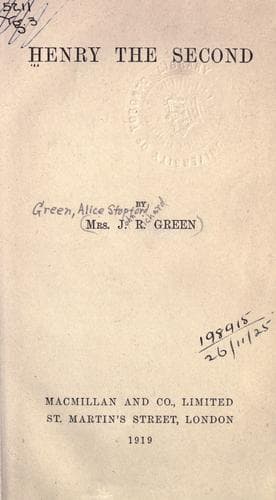
Great Britain -- History -- Henry II, 1154-1189; Henry II, King of England, 1133-1189
It was these new conditions of the national life which constituted the
real problem of government--a problem far more slow and difficult to work
out than the mere suppression of a turbulent baronage. In the rapid
movement towards material prosperity, the energies of the people were in
all directions breaking away from the channels and limits in which they
had been so long confined. Rules which had been sufficient for the
guidance of a simple society began to break down under the new fullness
and complexity of the national life, and the simple decisions by which
questions of property and public order had been solved in earlier times
were no longer possible. Moreover, a new confusion and uncertainty had
been brought into the law in the last hundred years by the effort to fuse
together Norman and English custom. Norman landlord or Norman sheriff
naturally knew little of English law or custom, and his tendency was
always to enforce the feudal rules which he practised on his Norman
estates. In course of time it came about that all questions of land-tenure
and of the relations of classes were regulated by a kind of double system.
The Englishman as well as the Norman became the "man" of his lord as in
Norman law, and was bound by the duties which this involved. On the other
hand, the Norman as well as the Englishman held his land subject to the
customary burdens and rights recognized by English law. Both races were
thus made equal before the law, and no legal distinction was recognized
between conqueror and conquered. There was, however, every element of
confusion and perplexity in the theory and administration of the law
itself, in the variety of systems which were contending for the mastery,
and in the inefficiency of the courts in which they were applied. English
law had grown up out of Teutonic custom, into which Roman tradition had
been slowly filtering through the Dark Ages Feudal law still bore traces
of its double origin in the system of the Teutonic "comitatus" and of the
Roman "beneficium." Forest law, which governed the vast extent of the
king's domains, was bound neither by Norman forms nor by English
traditions, but was framed absolutely at the king's will. Canon law had
been developed out of customs and precedents which had served to regulate
the first Christian communities, and which had been largely formed out of
the civil law of Rome. There was a multitude of local customs which
varied in every hundred and in every manor, and which were preserved by
the jealousy that prevailed between one village and another, the strong
sense of local life and jurisdiction, and the strict adherence to
immemorial traditions.
Public-domain text, read in full here on John Shaqi.
Reviews
Reviews
No reviews yet
Be the first to share your thoughts on this work.
Join the Discussion
Join the discussion
Sign in to leave a comment or review.
Sign InorCreate an account