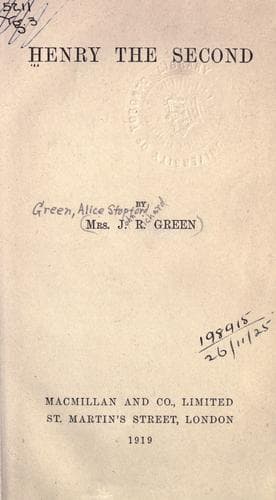
Great Britain -- History -- Henry II, 1154-1189; Henry II, King of England, 1133-1189
These different codes of law were administered in various courts of
divers origins. The tenant-in-chief of the king who was rich enough had
his cause carried to the King's Court of barons, where he was tried by his
peers. The poorer vassals, with the mass of the people, sought such
justice as was to be had in the old English courts, the Shire Court held
by the sheriff, and, where this survived, the Hundred Court summoned by
the bailiff. The lowest orders of the peasant class, shut out from the
royal courts, could only plead in questions of property in the manor
courts of their lords. The governing bodies of the richer towns were
winning the right to exercise absolute jurisdiction over the burghers
within their own walls. The Forest courts were held by royal officers, who
were themselves exempt from all jurisdiction save that of the king. And
under one plea or another all men in the State were liable for certain
causes to be brought under the jurisdiction of the newly established
Church courts. This system of conflicting laws was an endless source of
perplexity. The country was moreover divided into two nationalities, who
imperfectly understood one another's customary rights; and it was further
broken into various classes which stood in different relations to the law.
Those who had sufficient property were not only deemed entirely
trustworthy themselves, but were also considered answerable for the men
under them; a second class of freeholders held property sufficient to
serve as security for their own good behaviour, but not sufficient to make
them pledges for others; there was a third and lower class without
property, for whose good conduct the law required the pledge of some
superior. In a state of things so complicated, so uncertain and so
shifting, it is hard to understand how justice can ever have been
secured; nor, indeed, could any general order have been preserved,
save for the fact that these early courts of law, having all sprung
out of the same conditions of primitive life, and being all more or
less influenced and so brought to some common likeness by the Roman
law, did not differ very materially in their view of the relations
between the subjects of the State, and fundamentally administered the
same justice. Until this time too there had been but little legal
business to bring before the courts. There was practically no commerce;
there was little sale of land; questions of property were defined within
very narrow limits; a mass of contracts, bills of exchange, and all the
complicated transactions which trade brings with it, were only beginning
to be known. As soon, however, as industry developed, and the needs of a
growing society made themselves felt, the imperfections of the old order
became intolerable. The rude methods and savage punishments of the law
grew more and more burdensome as the number of trials increased; and the
popular courts were found to be fast breaking down under the weight of
Public-domain text, read in full here on John Shaqi.
Reviews
Reviews
No reviews yet
Be the first to share your thoughts on this work.
Join the Discussion
Join the discussion
Sign in to leave a comment or review.
Sign InorCreate an account