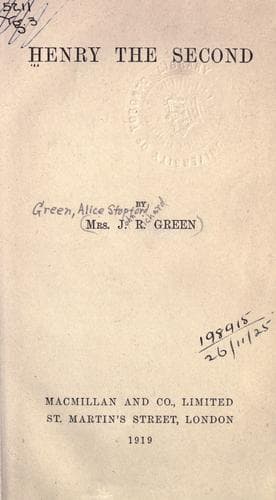
Great Britain -- History -- Henry II, 1154-1189; Henry II, King of England, 1133-1189
Such were in brief outline some of the difficulties which made order and
justice hard to win. Society was helpless to protect itself: news spread
slowly, the communication of thought was difficult, common action was
impossible. Amid all the shifting and half understood problems of
medieval times there was only one power to which men could look to protect
them against lawlessness, and that was the power of the king. No external
restraints were set upon his action; his will was without contradiction.
The medieval world with fervent faith believed that he was the very spring
and source of justice. In an age when all about him was changing, and when
there was no organized machinery for the administration of law, the king
had himself to be judge, lawgiver, soldier, financier, and administrator;
the great highways and rivers of the kingdom were in "his peace;" the
greater towns were in his demesne; he was guardian of the poor and
defender of the trader; he was finance minister in a society where
economic conditions were rapidly changing; here presented a developed
system of law as opposed to the primitive customs of feud and private war;
he was the only arbiter of questions that grew out of the new conflict of
classes and interests; he alone could decree laws at his absolute will and
pleasure, and could command the power to carry out his decrees; there was
not even a professional lawyer who was not in his court and bound to his
service.
Henry saw and used his opportunity. Even as a youth of twenty-one he
assumed absolute control in his courts with a knowledge and capacity which
made him fully able to meet trained lawyers, such as his chancellor,
Thomas, or his justiciar, De Lucy. Cool, businesslike, and prompt, he set
himself to meet the vast mass of arrears, the questions of jurisdiction
and of disputed property, which had arisen even as far back as the time of
Henry I., and had gone unsettled through the whole reign of Stephen, to
the ruin and havoc of the lands in question. He examined every charter
that came before him; if any was imperfect he was ready to draw one up
with his own hand; he watched every difficult point of law, noted every
technical detail, laid down his own position with brief decision. In the
uncertain and transitional state of the law the king's personal
interference knew scarcely any limits, and Henry used his power freely.
But his unswerving justice never faltered. Gilbert de Bailleul, in some
claim to property, ventured to make light of the charter of Henry I., by
which it was held. The king's wrath blazed up. "By the eyes of God," he
cried, "if you can prove this charter false, it would be worth a thousand
pounds to me! If," he went on, "the monks here could present such a
charter to prove their possession of Clarendon, which I love above all
places, there is no pretence by which I could refuse to give it up to
them!"
Public-domain text, read in full here on John Shaqi.
Reviews
Reviews
No reviews yet
Be the first to share your thoughts on this work.
Join the Discussion
Join the discussion
Sign in to leave a comment or review.
Sign InorCreate an account