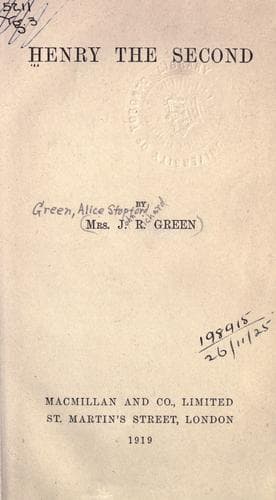
Great Britain -- History -- Henry II, 1154-1189; Henry II, King of England, 1133-1189
It is hard to realise the amazing physical endurance and activity which
was needed to do the work of a medieval king. Henry was never at rest. It
was only by the most arduous labour, by travel, by readiness of access to
all men, by inexhaustible patience in weighing complaint and criticism,
that he learned how the law actually worked in the remotest corners of
his land. He was scarcely ever a week in the same place; his life in
England was spent in continual progresses from south to north, from east
to west. The journeyings by rough trackways through "desert" and swamp
and forest, through the bleak moorlands of the Pennine Hills, or the
thickets and fens that choked the lower grounds, proved indeed a sore
trial for the temper of his courtiers; and bitter were the complaints of
the hardships that fell to the lot of the disorderly train that swept
after the king, the army of secretaries and lawyers, the mail-clad
knights and barons followed by their retainers, the archbishop and his
household, bishops and abbots and judges and suitors, with the "actors,
singers, dicers, confectioners, huxters, gamblers, buffoons, barbers, who
diligently followed the court." Knights and barons and clerks, accustomed
to the plenty and comfort of palace and castle, found themselves at the
mercy of every freak of the king's marshals, who on the least excuse
would roughly thrust them out into the night from the miserable hut in
which they sought shelter and cut loose their horses' halters, and whose
hearts were hardly softened by heavy bribes. They were often half-starved;
if food was to be had at all, it was at the best stale fish, sour beer and
wine, coarse black bread, and meat scarcely eatable, even with the rough
appetite of travellers of that age. Matters were made ten times worse by
Henry's mode of travelling. "If the king has proclaimed that he intends to
stop late in any place, you may be sure that he will start very early in
the morning, and with his sudden haste destroy every one's plans. It often
happens that those who have let blood or taken medicine are obliged at the
hazard of their lives to follow. You will see men running about like mad;
urging forward their pack-horses, driving their waggons into one another,
everything in confusion, as if hell had broken loose. Whereas, if the king
has given out that he will start early in the morning, he will certainly
change his mind, and you may be sure he will snore till noon. You will see
the pack-horses drooping under their loads, waggons waiting, drivers
nodding, tradesmen fretting, all grumbling at one another. Men hurry to
ask the loose women and the liquor retailers who follow the court when the
king will start; for these are the people who know most of the secrets of
the court." Sometimes, on the other hand, when the din of the camp was
silenced for a while in sleep, a sudden message from the royal lodging
would again set all in commotion. A wild clatter of horsemen and footmen
would fill the darkness.
Public-domain text, read in full here on John Shaqi.
Reviews
Reviews
No reviews yet
Be the first to share your thoughts on this work.
Join the Discussion
Join the discussion
Sign in to leave a comment or review.
Sign InorCreate an account