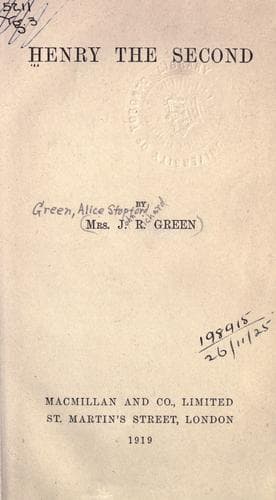
Great Britain -- History -- Henry II, 1154-1189; Henry II, King of England, 1133-1189
The duties of police were at that time performed by the whole population,
and the judges' circuits brought home sharply to every man the part he
was expected to play in the suppression of crime. Juries were fined if
they had not "presented" a due amount of criminals; townships were fined
if they had not properly pursued malefactors; villages were fined if a hut
was burned down and the hue and cry was not raised, or if a criminal who
had fled for refuge to their church escaped from it. A robber or murderer
must be paid for by his "pledge," or if he had no pledge, a fine fell on
his village or township; if a dead body were found and the slayer not
produced, the hundred must pay for him, unless a legal form, called
"proving his Englishry," could be gone through--a condition which was
constantly impossible; the township was fined if the body had been buried
before the coming of the coroner; abbot or knight or householder was
heavily taxed for every crime of serf or hired servant under him, or even
for the offences of any starving and worn-out pilgrim or traveller to
whom he had given a three days' shelter.. In the remotest regions of the
country barons and knights and freeholders were called to aid in carrying
out the law. The "jurors" must be ready at the judges' summons wherever
and whenever they were wanted. They must be prepared to answer fully for
their district; they must expect to be called on all sorts of excuses to
Westminster itself, and no hardships of the journey from the farthest
corner of the land might keep them back. The "knights of the shire" were
summoned as "recognitors" to give their testimony in all questions of
property, public privilege, rights of trade, local liberties, exemption
from taxes; if the king demanded an "aid" for the marriage of his daughter
or the coming of age of his son, they assessed the amount to be paid; if
he wanted to count an estate among the royal Forests, it was they who
decided whether the land was his by ancient right. They were employed
too in all kinds of business for the Court; they might be sent to
examine a criminal who had fled to the refuge of a church, or to see
whether a sick man had appointed an attorney, or whether a litigant who
pleaded illness was really in bed without his breeches. If in any case
the verdict of the Shire Court was disputed, they were summoned to
Westminster to repeat the record of the county. No people probably ever
went through so severe a discipline or received so efficient a training
in the practical work of carrying out the law, as was given to the
English people in the hundred years that lay between the Assize of
Clarendon in 1166 and the Parliament summoned by De Montfort in 1265,
where knights from every shire elected in the county court were called
to sit with the bishops and great barons in the common Parliament of the
realm.
Public-domain text, read in full here on John Shaqi.
Reviews
Reviews
No reviews yet
Be the first to share your thoughts on this work.
Elsewhere in the archive
Join the Discussion
Join the discussion
Sign in to leave a comment or review.
Sign InorCreate an account