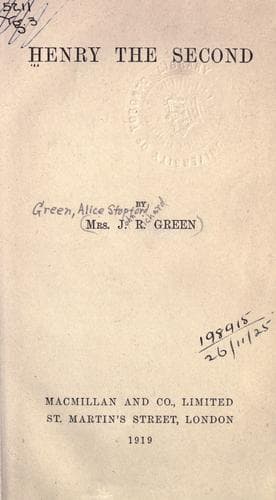
Great Britain -- History -- Henry II, 1154-1189; Henry II, King of England, 1133-1189
In the pitiless routine of their work, however, the barons of the
Exchequer were at this early time scarcely regarded as judges administering
justice so much as tax-gatherers for a needy treasury. Baron and churchman
and burgher alike saw every question turn to a demand of money to swell
the royal Hoard; jurors were fined for any trifling flaw in legal
procedure; widows were fined for leave to marry, guardians for leave to
receive their wards; if a peasant were kicked by his horse, if in fishing
he fell from the side of his boat, or if in carrying home his eels or
herrings he stumbled and was crushed by the cart-wheel, his wretched
children saw horse or boat or cart with its load of fish which in older
days had been forfeited as "deodand" to the service of God, now carried
off to the king's Hoard; if a miller was caught in the wheel of his mill
the sheriff must see the price of it paid to the royal treasury. In the
country districts where coin was perhaps scarcely ever seen, where
wages were unknown, and such little traffic as went on was wholly a
matter of barter, the peasants must often have been put to the greatest
straits to find money for the fines. Year after year baron as well as
peasant and farmer saw his waggons and horses, or his store of honey,
eggs, loaves, beer, the fish from his pond or the fowls from his yard,
claimed by the purveyors who provided for the judges and their followers,
and paid for by such measures and such prices as seemed good to the greedy
contractors. The people at large groaned under the heavy burden of fines
and penalties and charges for the maintenance of an unaccustomed justice.
When in the visitations of 1168 the judges had to collect, besides the
ordinary dues, an "aid" for the marriage of the king's eldest daughter,
the unhappy tax-payers, recognizing in their misery no distinctions,
attributed all their sufferings to the new reform, and saw in their king
not a ruler who desired righteous judgment, but one who only thirsted
after gain. The one privilege which seemed worth fighting for or worth
buying was the privilege of assessing their own fines and managing their
own courts. Half a century later we see the prevailing terror at a visit
of the judges to Cornwall, when all the people fled for refuge to the
woods, and could hardly be compelled or persuaded to come back again.
Yet later the people won a concession that in time of war no circuits
should be held, so that the poor should not be utterly ruined.
Public-domain text, read in full here on John Shaqi.
Reviews
Reviews
No reviews yet
Be the first to share your thoughts on this work.
Elsewhere in the archive
Join the Discussion
Join the discussion
Sign in to leave a comment or review.
Sign InorCreate an account