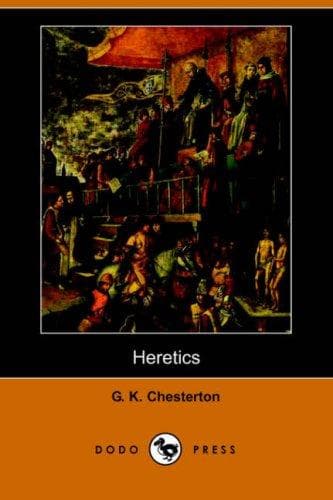
Apologetics; Chesterton, G. K. (Gilbert Keith), 1874-1936
It is not that one article which we consider costly and beautiful is
being ousted by another kind of article which we consider common or
unclean. It is that of the same article a worse quality is preferred to
a better. If you like popular journalism (as I do), you will know that
Pearson’s Magazine is poor and weak popular journalism. You will know
it as certainly as you know bad butter. You will know as certainly
that it is poor popular journalism as you know that the Strand, in the
great days of Sherlock Holmes, was good popular journalism. Mr. Pearson
has been a monument of this enormous banality. About everything he says
and does there is something infinitely weak-minded. He clamours for
home trades and employs foreign ones to print his paper. When this
glaring fact is pointed out, he does not say that the thing was an
oversight, like a sane man. He cuts it off with scissors, like a child
of three. His very cunning is infantile. And like a child of three,
he does not cut it quite off. In all human records I doubt if there is
such an example of a profound simplicity in deception. This is the
sort of intelligence which now sits in the seat of the sane and
honourable old Tory journalism. If it were really the triumph of the
tropical exuberance of the Yankee press, it would be vulgar, but still
tropical. But it is not. We are delivered over to the bramble, and
from the meanest of the shrubs comes the fire upon the cedars of
Lebanon.
The only question now is how much longer the fiction will endure that
journalists of this order represent public opinion. It may be doubted
whether any honest and serious Tariff Reformer would for a moment
maintain that there was any majority for Tariff Reform in the country
comparable to the ludicrous preponderance which money has given it
among the great dailies. The only inference is that for purposes of
real public opinion the press is now a mere plutocratic oligarchy.
Doubtless the public buys the wares of these men, for one reason or
another. But there is no more reason to suppose that the public admires
their politics than that the public admires the delicate philosophy of
Mr. Crosse or the darker and sterner creed of Mr. Blackwell. If these
men are merely tradesmen, there is nothing to say except that there are
plenty like them in the Battersea Park Road, and many much better. But
if they make any sort of attempt to be politicians, we can only point
out to them that they are not as yet even good journalists.
IX. The Moods of Mr. George Moore
Public-domain text, read in full here on John Shaqi.
Reviews
Reviews
No reviews yet
Be the first to share your thoughts on this work.
Join the Discussion
Join the discussion
Sign in to leave a comment or review.
Sign InorCreate an account