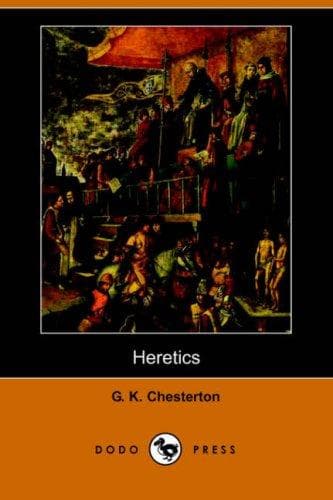
Apologetics; Chesterton, G. K. (Gilbert Keith), 1874-1936
Mr. George Moore began his literary career by writing his personal
confessions; nor is there any harm in this if he had not continued them
for the remainder of his life. He is a man of genuinely forcible mind
and of great command over a kind of rhetorical and fugitive conviction
which excites and pleases. He is in a perpetual state of temporary
honesty. He has admired all the most admirable modern eccentrics until
they could stand it no longer. Everything he writes, it is to be fully
admitted, has a genuine mental power. His account of his reason for
leaving the Roman Catholic Church is possibly the most admirable
tribute to that communion which has been written of late years. For the
fact of the matter is, that the weakness which has rendered barren the
many brilliancies of Mr. Moore is actually that weakness which the
Roman Catholic Church is at its best in combating. Mr. Moore hates
Catholicism because it breaks up the house of looking-glasses in which
he lives. Mr. Moore does not dislike so much being asked to believe in
the spiritual existence of miracles or sacraments, but he does
fundamentally dislike being asked to believe in the actual existence of
other people. Like his master Pater and all the aesthetes, his real
quarrel with life is that it is not a dream that can be moulded by the
dreamer. It is not the dogma of the reality of the other world that
troubles him, but the dogma of the reality of this world.
The truth is that the tradition of Christianity (which is still the
only coherent ethic of Europe) rests on two or three paradoxes or
mysteries which can easily be impugned in argument and as easily
justified in life. One of them, for instance, is the paradox of hope or
faith—that the more hopeless is the situation the more hopeful must be
the man. Stevenson understood this, and consequently Mr. Moore cannot
understand Stevenson. Another is the paradox of charity or chivalry
that the weaker a thing is the more it should be respected, that the
more indefensible a thing is the more it should appeal to us for a
certain kind of defence. Thackeray understood this, and therefore Mr.
Moore does not understand Thackeray. Now, one of these very practical
and working mysteries in the Christian tradition, and one which the
Roman Catholic Church, as I say, has done her best work in singling
out, is the conception of the sinfulness of pride. Pride is a weakness
in the character; it dries up laughter, it dries up wonder, it dries up
chivalry and energy. The Christian tradition understands this;
therefore Mr. Moore does not understand the Christian tradition.
Public-domain text, read in full here on John Shaqi.
Reviews
Reviews
No reviews yet
Be the first to share your thoughts on this work.
Join the Discussion
Join the discussion
Sign in to leave a comment or review.
Sign InorCreate an account