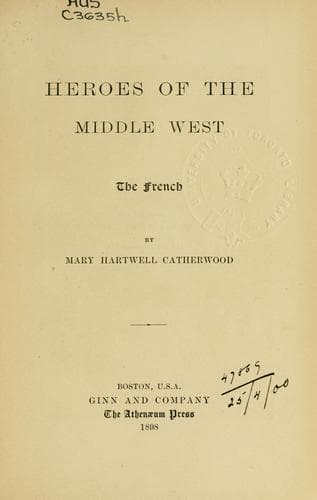
Heroes of the Middle West: The French — John Shaqi
Heroes of the Middle West: The FrenchCatherwood, Mary Hartwell
History
Heroes of the Middle West: The French
Catherwood, Mary Hartwell
Mississippi River Valley -- Discovery and exploration; Mississippi River Valley -- History -- To 1803
Already the Miami tribe was following him, and he drew them into an
alliance with the Illinois, impressively founding the principality soon
to grow there. This eloquent Norman Frenchman had gifts in height and
the large bone and sinew of Normandy, which his Indian allies always
admired. And he well knew where to impress his talk with coats, shirts,
guns, and hunting-knives. As his holdings of land in Canada were made
his stepping-stones toward the west, so the footing he gained at Fort
Miamis and in the Illinois country was to be used in discovering the
real course of the Mississippi and taking possession of its vast basin.
It was the end of May before he met Tonty at St. Ignace; Italian and
Frenchman coming together with outstretched arms and embracing. Tonty's
black eyes were full of tears, but La Salle told his reverses as calmly
as if they were another man's.
"Any one else," said Father Membre, who stood by, "would abandon the
enterprise, but Monsieur de la Salle has no equal for constancy of
purpose."
"But where is Father Ribourde?" La Salle inquired, missing the other
Recollet.
Tonty told him sorrowfully how Father Ribourde had gone into the woods
when his party camped, after being driven up river in a leaky boat by
the Iroquois; how they had waited and searched for him, and were finally
made aware that a band of prowling Kickapoos had murdered him.
Tonty had aimed at Green Bay by the Chicago portage, and tramped along
the west shore of Lake Michigan, having found it impossible to patch the
boat.
"We were nearly starved," he said; "but we found a few ears of corn and
some frozen squashes in a deserted Indian town. When we reached the bay
we found an old canoe and mended it; but as soon as we were on the water
there rose a northwest wind with driving snow, which lasted nearly five
days. We ate all our food, and, not knowing what to do, turned back to
the deserted town to die by a warm fire in one of the wigwams. On the
way the bay froze. We camped to make moccasins out of Father Membre's
cloak. I was angry at Etienne Renault for not finishing his; but he
excused himself on account of illness, having a great oppression of the
stomach, caused by eating a piece of an Indian rawhide shield which he
could not digest. His delay proved our salvation, for the next day, as I
was urging him to finish the moccasins, a party of Ottawas saw the smoke
of our fire and came to us. We gave them such a welcome as never was
seen before. They took us into their canoes and carried us to an Indian
village only two leagues off. All the Indians took pleasure in sending
us food; so, after thirty-four days of starvation, we found our famine
turned to abundance."
Tonty and La Salle, with their followers, paddled the thousand miles to
Fort Frontenac, to make another start into the wilderness.
Public-domain text, read in full here on John Shaqi.
Reviews
Reviews
No reviews yet
Be the first to share your thoughts on this work.
Join the Discussion
Join the discussion
Sign in to leave a comment or review.
Sign InorCreate an account