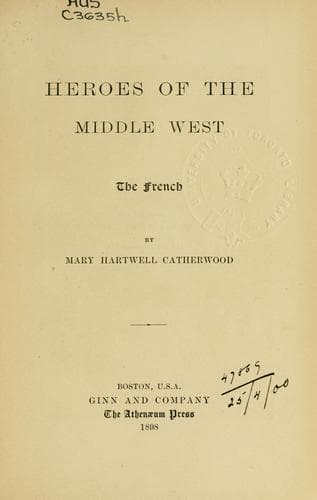
Heroes of the Middle West: The French — John Shaqi
Heroes of the Middle West: The FrenchCatherwood, Mary Hartwell
History
Heroes of the Middle West: The French
Catherwood, Mary Hartwell
Mississippi River Valley -- Discovery and exploration; Mississippi River Valley -- History -- To 1803
La Salle was now determined to keep his men together. He set down many
of his experiences and thoughts in letters which have been kept; so we
know at this day what was in the great explorer's mind, and how dear he
held "Monsieur de Tonty, who is full of zeal."
On his return to the wilderness with another equipment, he went around
the head of Lake Michigan and made the short Chicago portage to the
Desplaines River. Entering by this branch the frozen Illinois, they
dragged their canoes on sledges past the site of the town and reached
open water below Peoria Lake. La Salle gave up the plan of building a
ship, and determined to go on in his canoes to the mouth of the
Mississippi.
So, pausing to hunt when game was needed, his company of fifty-four
persons entered the great river, saw the Missouri rushing into it--muddy
current and clear northern stream flowing alongside until the waters
mingled. They met and overawed the Indians on both shores, building
several stockades. The broad river seemed to fill a valley, doubling and
winding upon itself with innumerable curves, in its solemn and lonely
stretches. Huge pieces of low-lying bank crumbled and fell in with
splashes, for the Mississippi ceaselessly eats away its own shore.
A hundred leagues below the mouth of the Arkansas they came to a swamp
on the west side. Behind this swamp, they had been told, might be found
the Arkansas tribe's great town. La Salle sent Tonty and Father Membre,
with some voyageurs, to make friends with the Indians and bring him word
about the town.
Tonty had seen nothing like it in the New World. The houses were large
and square, of sun-baked brick, with a dome of canes overhead. The two
largest were the chief's house and the temple. Doors were the only
openings. Tonty and the friar were taken in where the chief sat on a
bedstead with his squaws, and sixty old men, in white mulberry bark
cloaks, squatted by with the dignity of a council. The wives, in order
to honor the sovereign, yelled.
The temple was a place where dead chiefs' bones were kept. A mud wall
built around it was ornamented with skulls. The inside was very rough.
Something like an altar stood in the center of the floor; and a fire of
logs was kept burning before it, and never allowed to go out, filling
the place with smoke, and irritating the eyes of two old Indians who
tended it in half darkness. The Frenchmen were not allowed to look into
a secret place where the temple treasure was kept. But, hearing it
consisted of pearls and trinkets, Tonty conjectured the Indians had got
it from the Spanish. This tribe was not unlike the Aztecs of Mexico.
The chief came in barbaric grandeur to visit La Salle, dressed in white,
having fans carried before him, and a plate of burnished copper to
represent the sun, for these lower Mississippians were sun-worshipers.
Public-domain text, read in full here on John Shaqi.
Reviews
Reviews
No reviews yet
Be the first to share your thoughts on this work.
Join the Discussion
Join the discussion
Sign in to leave a comment or review.
Sign InorCreate an account