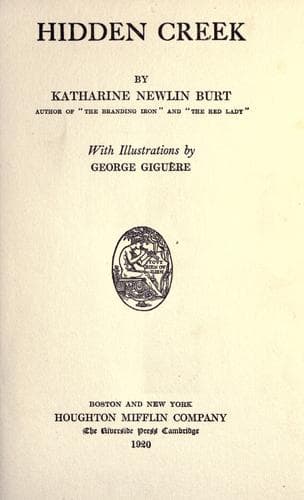
Frontier and pioneer life -- West (U.S.) -- Fiction; Orphans -- Fiction; Young women -- Fiction
Sheila, alone there in the garret studio above the city, cried to her
father and shook him, till, in very terror of her own frenzy in the face
of his stillness, she grew calm and laid herself down beside him, put his
dead arm around her, nestled her head against his shoulder. She was
seventeen years old, left alone and penniless in the old world that he
had just pronounced so good. She lay there staring at the stars till they
faded, and the cold, clear eye of day looked down into the room.
CHAPTER II
SYLVESTER HUDSON COMES FOR HIS PICTURE
Back of his sallow, lantern-jawed face, Sylvester Hudson hid
successfully, though without intention, all that was in him whether of
good or ill. Certainly he did not look his history. He was
stoop-shouldered, pensive-eyed, with long hands on which he was always
turning and twisting a big emerald. He dressed quietly, almost correctly,
but there was always something a little wrong in the color or pattern of
his tie, and he was too fond of brown and green mixtures which did not
become his sallowness. He smiled very rarely, and when he did smile, his
long upper lip unfastened itself with an effort and showed a horizontal
wrinkle halfway between the pointed end of his nose and the irregular,
nicked row of his teeth.
Altogether, he was a gentle, bilious-looking sort of man, who might have
been anything from a country gentleman to a moderately prosperous clerk.
As a matter of fact, he was the owner of a dozen small, not too
respectable, hotels through the West, and had an income of nearly half a
million dollars. He lived in Millings, a town in a certain Far-Western
State, where flourished the most pretentious and respectable of his
hotels. It had a famous bar, to which rode the sheep-herders, the
cowboys, the ranchers, the dry-farmers of the surrounding country--yes,
and sometimes, thirstiest of all, the workmen from more distant
oil-fields, a dangerous crew. Millings at that time had not yielded to
the generally increasing "dryness" of the West. It was "wet,"
notwithstanding its choking alkali dust; and the deep pool of its
wetness lay in Hudson's bar, The Aura. It was named for a woman who had
become his wife.
When Hudson came to New York he looked up his Eastern patrons, and it was
one of these who, knowing Arundel's need, encouraged the hotel-keeper in
his desire to secure a "jim-dandy picture" for the lobby of The Aura and
took him for the purpose to Marcus's studio. On that morning, hardly a
fortnight before the artist's death, Sheila was not at home.
Public-domain text, read in full here on John Shaqi.
Reviews
Reviews
No reviews yet
Be the first to share your thoughts on this work.
Join the Discussion
Join the discussion
Sign in to leave a comment or review.
Sign InorCreate an account