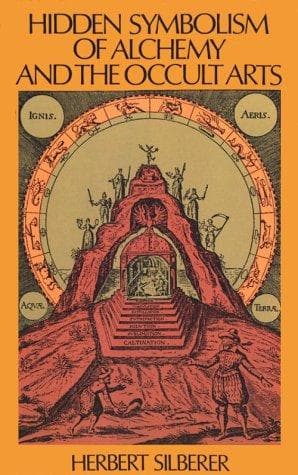
Hidden Symbolism of Alchemy and the Occult Arts — John Shaqi
Hidden Symbolism of Alchemy and the Occult ArtsSilberer, Herbert
Religion
Hidden Symbolism of Alchemy and the Occult Arts
Silberer, Herbert
Alchemy; Society of Rosicrucians; Symbolism (Psychology)
Hidden Symbolism of
ALCHEMY and the OCCULT ARTS
(Formerly titled: _Problems of Mysticism and Its Symbolism_)
by Dr. Herbert Silberer
Translated by Smith Ely Jelliffe, M.D., Ph.D.
Dover Publications, Inc.
New York
1971
CONTENTS
Translator’s Preface
Part I. The Parable.
Section I. The Parable.
Section II. Dream And Myth Interpretation.
Part II. Analytic Part.
Section I. Psychoanalytic Interpretation Of The Parable.
Section II. Alchemy.
Section III. The Hermetic Art.
Section IV. Rosicrucianism And Freemasonry.
Section V. The Problem Of Multiple Interpretation.
Part III. Synthetic Part.
Section I. Introversion And Regeneration.
A. Introversion And Intro-Determination.
B. Effects Of Introversion.
C. Regeneration.
Section II. The Goal Of The Work.
Section III. The Royal Art.
Notes.
Bibliography.
Index.
Footnotes
This Dover edition, first published in 1971, is an unabridged and
unaltered republication of the work originally published by Moffat, Yard
and Company, New York, in 1917 under the title _Problems of Mysticism and
its Symbolism_.
_International Standard Book Number: 0-486-20972-5_
_Library of Congress Catalog Card Number: 74-176356_
TRANSLATOR’S PREFACE
Prominent among the stones of a fireplace in my country den, one large
rounded giant stands out. It was bourne by the glacial streams from a more
northern resting place and is marked by a fossil of a mollusk that
inhabited northern seas many million years ago. Yet in spite of the eons
of time that have passed it can be compared with specimens of mollusks
that live to-day. Down through the countless centuries the living stream
has carved its structural habitations in much the same form. The science
of Paleontology has collected this history and has attempted a
reconstruction of life from its beginnings.
The same principle here illustrated is true for the thought-life of
mankind. The forms in which it has been preserved however are not so
evident. The structuralizations are not so definite. If they were,
evolution would not have been possible for the living stream of energy
which is utilized by mind-stuff cannot be confined if it would advance to
more complex integrations. Hence the products of mind in evolution are
more plastic—more subtle and more changing. They are to be found in the
myths and the folk-lore of ancient peoples, the poetry, dramatic art, and
the language of later races. From age to age however the strivings
continue the same. The living vessels must continue and the products
express the most fundamental strivings, in varying though related forms.
Public-domain text, read in full here on John Shaqi.
Reviews
Reviews
No reviews yet
Be the first to share your thoughts on this work.
Join the Discussion
Join the discussion
Sign in to leave a comment or review.
Sign InorCreate an account