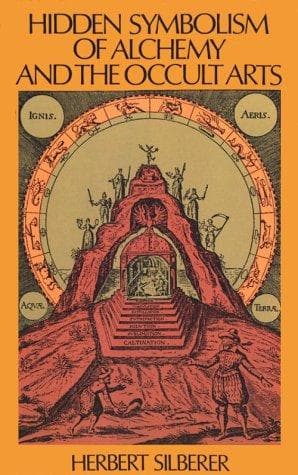
Hidden Symbolism of Alchemy and the Occult ArtsSilberer, Herbert
Religion
Hidden Symbolism of Alchemy and the Occult Arts
Silberer, Herbert
Alchemy; Society of Rosicrucians; Symbolism (Psychology)
We thus arrive at a science which may be called paleo-psychology. Its
fossils are the thought-forms throughout the ages, and such a science
seeks to show fundamental likenesses behind the more superficial
dissimilarities.
The present work is a contribution to such a science in that it shows the
essential relationships of what is found in the unconscious of present day
mankind to many forms of thinking of the middle ages. These same trends
are present to-day in all of us though hidden behind a different set of
structural terms, utilizing different mechanisms for energy expression.
The unceasing complexity of life’s accumulations has created a great
principle for energy expression—it is termed sublimation—and in popular
parlance represents the spiritual striving of mankind towards the
perfecting of a relation with the world of reality—the environment—which
shall mean human happiness in its truest sense. One of the products of
this sublimation tendency is called Mysticism. This work would seek to aid
us to an understanding of this manifestation of human conduct as expressed
in concrete or contemplated action through thought. It does so by the
comparative method, and it is for this reason I have been led to present
it to an English reading public.
Much of the strange and outre, as well as the commonplace, in human
activity conceals energy transformations of inestimable value in the work
of sublimation. The race would go mad without it. It sometimes does even
with it, a sign that sublimation is still imperfect and that the race is
far from being spiritually well. A comprehension of the principles here
involved would further the spread of sympathy for all forms of thinking
and tend to further spiritual health in such mutual comprehension of the
needs of others and of the forms taken by sublimation processes.
For the actual work of translation, I wish to express my obligations to
friends Wilfred Lay, and Leo Stein. Without their generous and gifted
assistance I would not have been able to accomplish the task.
SMITH ELY JELLIFFE, M.D.
NEW YORK, Oct. 27, 1917.
Part I.
THE PARABLE.
Section I.
The Parable.
In an old book I discovered an extraordinary narrative entitled Parabola.
I take it as the starting point of my observations because it affords a
welcome guide. In the endeavor to understand the parable and get a
psychological insight into it, we are led on to journey through these very
realms of fancy, into which I should like to conduct the reader. At the
end of our journey we shall have acquired, with the understanding of the
first example, the knowledge of certain psychical laws.
Public-domain text, read in full here on John Shaqi.
Reviews
Reviews
No reviews yet
Be the first to share your thoughts on this work.
Join the Discussion
Join the discussion
Sign in to leave a comment or review.
Sign InorCreate an account