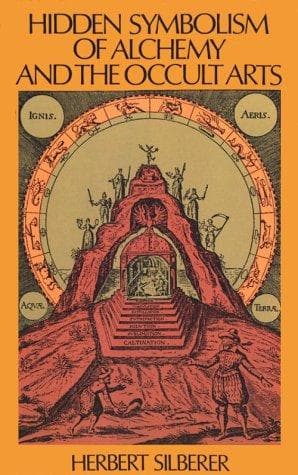
Hidden Symbolism of Alchemy and the Occult ArtsSilberer, Herbert
Religion
Hidden Symbolism of Alchemy and the Occult Arts
Silberer, Herbert
Alchemy; Society of Rosicrucians; Symbolism (Psychology)
Besides the early Christian ideal, which recognized and encouraged the
connection between the teachings of Christ and the ancient wisdom of
platonism, there was in early times another which emphasized and
endeavored to develop the antithesis more than the connection. From the
time when the new Christian state church came to life, and sacrificial
religion and the belief in devils and the priesthood were restored, a
struggle of life and death developed between the church and the so-called
philosophic schools. “The fraternity saw that it had to draw down the mask
still further over its face than formerly, and the ‘House of the Eternal,’
the ‘Basilika,’ the ‘Academies,’ and the ‘Museums’ became workshops of
stone cutters, latomies, and loggia or innocent guilds, unions, and
companies of every variety. But all later greater religious movements and
tendencies which maintained the old beliefs, whether they appeared under
the names of mysticism, alchemy, natural philosophy, humanism, or special
names and disguises, as workshops or societies, have preserved more or
less truly the doctrine of the ‘sacred numbers’ and the number symbolism,
and found the keys of wisdom and knowledge in the rightly understood
doctrine of the eternal harmony of the spheres.” (Keller, l. c., p. 38.)
Keller derives modern freemasonry from the academies of the renaissance,
which, as we have just heard, continued the spirit of the ancient
academies. Now it is interesting that the later branches of these
religious societies (after the renaissance) took among others the form of
alchemy companies and further that such fraternities or companies [as are
not called alchemical], still employed symbols that we recognize as
derived from alchemy. The hieroglyphics of alchemy appear to be peculiarly
appropriate to the religious and philosophic ideas to be treated of.
Rosicrucianism was, however, one of the forms into which alchemy was
organized. It is further important that in just those societies of the
beginning of the seventeenth century which outsiders called “alchymists”
or “rosicrucians,” the characteristic emblems of the old lodge appeared,
as, for instance, the circle, the cubic stone, the level, the man facing
the right, the sphere, the oblong rectangle (symbol of the Lodge), etc.
(Keller, Zur Gesch. d. Bauh., p. 17.) These “alchymists” honored St. John
in the same way as can be shown for the companies of the fifteenth
century. I need not mention that modern masonry, in its most important
form, bears the name of Masons of St. John.
Public-domain text, read in full here on John Shaqi.
Reviews
Reviews
No reviews yet
Be the first to share your thoughts on this work.
Elsewhere in the archive
Join the Discussion
Join the discussion
Sign in to leave a comment or review.
Sign InorCreate an account