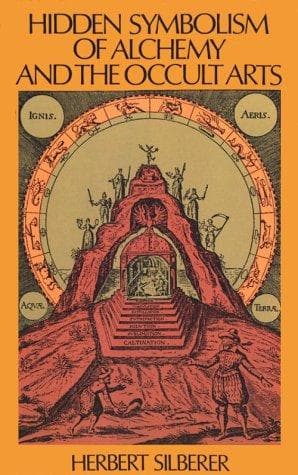
Hidden Symbolism of Alchemy and the Occult ArtsSilberer, Herbert
Religion
Hidden Symbolism of Alchemy and the Occult Arts
Silberer, Herbert
Alchemy; Society of Rosicrucians; Symbolism (Psychology)
[21]. Here he rested for a few days and called to me to open the
door. Methought, however, that he was much more beautiful, more
ruddy and lordly, which he then also remarked and deemed it a
lordly and wholesome water, drank much of it, more than before so
that I was resolved to build the chamber much larger. [Evidently
because the inmate increased in size.] When now the king had drunk
to his satisfaction of this precious drink, which yet the
unknowing regard as nothing he became so beautiful and lordly,
that in my whole life I never saw a more lordly person nor more
lordly demeanor. Then he led me into his kingdom, and showed me
all the treasures and riches of the world, so that I must confess,
that not only had the queen announced the truth, but also had
omitted to describe the greater part of it as it seemed to those
that know it. For there was no end of gold and noble carbuncle
there; rejuvenation and restoration of natural forces, and also
recovery of lost health, and removal of all diseases were a common
thing in that place. The most precious of all was that the people
of that land knew their creator, feared and honored him, and asked
of him wisdom and understanding, and finally after this transitory
glory an everlasting blessedness. To that end help us God the
Father, Son and Holy Ghost. Amen.
The author of the preceding narrative calls it a parable. Its significance
may have indeed appeared quite transparent to him, and he presupposes that
the readers of his day knew what form of learning he masked in it. The
story impresses us as rather a fairy story or a picturesque dream. If we
compare parables that come nearer to our modern point of view and are
easily understood on account of their simplicity, like those of Ruckert or
those of the New Testament, the difference can be clearly seen. The
unnamed author evidently pursues a definite aim; one does find some unity
in the bizarre confusion of his ideas; but what he is aiming at and what
he wishes to tell us with his images we cannot immediately conceive. The
main fact for us is that the anonymous writer speaks in a language that
shows decided affinity with that of dreams and myths. Therefore, however
we may explain in what follows the peculiarly visionary character of the
parable, we feel compelled to examine it with the help of a psychological
method, which, endeavoring to get from the surface to the depths, will be
able to trace analytically the formative powers of the dream life and
allied phenomena, and explain their mysterious symbols.
Public-domain text, read in full here on John Shaqi.
Reviews
Reviews
No reviews yet
Be the first to share your thoughts on this work.
Join the Discussion
Join the discussion
Sign in to leave a comment or review.
Sign InorCreate an account