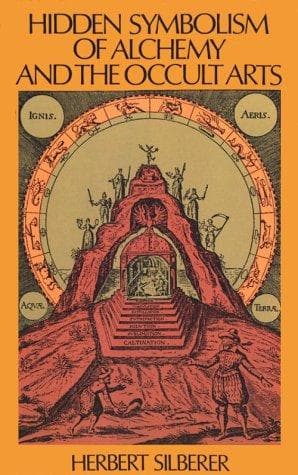
Hidden Symbolism of Alchemy and the Occult ArtsSilberer, Herbert
Religion
Hidden Symbolism of Alchemy and the Occult Arts
Silberer, Herbert
Alchemy; Society of Rosicrucians; Symbolism (Psychology)
I have still to reveal in what book and in what circumstances the parable
appears. It is in the second volume of a book “Geheime Figuren der
Rosenkreuzer aus dem 16ten und 17ten Jahrhundert,” published at Altona
about 1785-90. Its chief contents are large plates with pictorial
representations and with them a number of pages of text. According to a
note on the title page, the contents are “for the first time brought to
light from an old manuscript.” The parable is in the second volume of a
three-volume series which bears the subtitle: Ein güldener Tractat vom
philosophischen Steine. Von einem noch lebenden, doch ungenannten
Philosopho, den Filiis doctrinae zur Lehre, den Fratribus Aureae Crucis
aber zur Nachrichtung beschrieben. Anno, M.D.C.XXV.
If I add that this book is an hermetic treatise (alchemistic), it may
furnish a general classification for it, but will hardly give any definite
idea of its nature, not merely on account of the oblivion into which this
kind of writing has now fallen, but also because the few ideas usually
connected with it produce a distorted picture. The hermetic art, as it is
treated here, the principles of which strike us to-day as fantastic, is
related to several “secret” sciences and organizations, some of which have
been discredited: magic, kabbala, rosicrucianism, etc. It is particularly
closely connected with alchemy so that the terms “hermetic art” and
“alchemy” (and even “royal art”) are often used synonymously. This
“art”—to call it by the name that not without some justification it
applies to itself—leads us by virtue of its many ramifications into a
large number of provinces, which furnish us desirable material for our
research.
So I will first, purposely advancing on one line, regard the parable as a
dream or a fairy tale and analyze it psychoanalytically. This treatment
will, for the information of the reader, be preceded by a short exposition
of psychoanalysis as a method of interpretation of dreams and fairy tales.
Then I will, still seeking for the roots of the matter, introduce the
doctrines that the pictorial language of the parable symbolizes. I will
give consideration to the chemical viewpoint of alchemy and also the
hermetic philosophy and its hieroglyphic educational methods.
Public-domain text, read in full here on John Shaqi.
Reviews
Reviews
No reviews yet
Be the first to share your thoughts on this work.
Join the Discussion
Join the discussion
Sign in to leave a comment or review.
Sign InorCreate an account