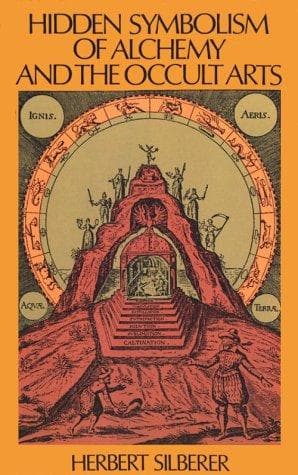
Hidden Symbolism of Alchemy and the Occult ArtsSilberer, Herbert
Religion
Hidden Symbolism of Alchemy and the Occult Arts
Silberer, Herbert
Alchemy; Society of Rosicrucians; Symbolism (Psychology)
The religious-mystical applications of the fundamental powers represented
by the types, in the sense of a sublimation, does not manifest therefore
in contrast to their retrospective form (titanic, purposeless form) an
essentially foreign nature; the important novelty in them is that they no
longer are used egotistically but have acquired a content that is
ethically valuable, to which the intro-determination was an aid. This
determination, whose external aspects we have noticed in the types or
symbols, is only the visible expression of a far more important actual
intro-determination whose accomplishment lies in an amplification of
personality, and will later be considered in detail.
In the psychoanalytic consideration of the alchemistic parable it would
appear that only the titanic impulses were realized there, e.g., to have
the mother as a lover and to kill the father. Now it corresponds to a
really significant intro-determination when we hear that in the
alchemistic work the father is the same as the son, and when we understand
that the father is a state, or psychic potentiality, of the “son,” whom
the latter in himself, has to conquer, exactly in the same manner as Lea
in the lecomantic study strove to put off the old man.
The alchemist Rulandus (Lex., p. 24) quotes the “Turba”: “Take the white
tree, build him a round, dark, dew-encircled house, and set in it a
hundred year-old man and close it so that no wind or dust can get to him
(introversion); then leave him there eight days. I tell you that that man
will not cease to eat of the fruit of that tree till he becomes a youth. O
what a wonderful nature, for here is the father become son and born
again.” Ibid: “The stone [that is in the anagogic sense, man] is at first
the senex, afterwards young, so it is said filius interficit patrem; the
father must die, the son be born, die with each other and be renewed with
each other.”
We must proceed similarly if we wish to interpret the parable
anagogically.
What I have already taken from the anagogic fairy tale interpretation as a
symbol of introversion shows, of course, also the character of
intro-determination.
Public-domain text, read in full here on John Shaqi.
Reviews
Reviews
No reviews yet
Be the first to share your thoughts on this work.
Elsewhere in the archive
Join the Discussion
Join the discussion
Sign in to leave a comment or review.
Sign InorCreate an account