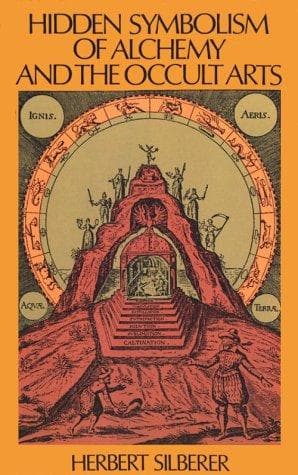
Hidden Symbolism of Alchemy and the Occult ArtsSilberer, Herbert
Religion
Hidden Symbolism of Alchemy and the Occult Arts
Silberer, Herbert
Alchemy; Society of Rosicrucians; Symbolism (Psychology)
In contrast to the miraculous knowledge we find in the dream a peculiar
unsureness in many things, particularly in those which concern the
personality of the wanderer. When the elders inform the wanderer that he
must marry the woman that he has taken, he does not know clearly whether
the matter at all concerns him or not; a remarkable fluctuation in his
attitude takes place. We wonder whether he has taken on the rôle of the
bridegroom or, quite the reverse, the bridegroom has taken the wanderer’s.
We are likewise struck by similar uncertainties, like those during the
walk on top of the wall where the wanderer is followed by some one, of
whom he does not know whether it is a man or a woman. Here belong also
those passages of the narrative introduced by the wanderer with “as if,”
etc. In the search for the gardener’s house he chances upon many people
and “it seems” that he has himself done what these people are there doing.
Quite characteristic also are the different obstructions and other
difficulties placed in the path of the wanderer. Even in the first
paragraph of the narrative we hear that he is startled, would gladly turn
back, but cannot because a strong wind prevents him. On top of the wall
the railing makes his progress difficult; on other occasions a wall, or a
door. The first experience, especially, recalls those frequent occurrences
in dreams where, anxiously turning in flight or oppressed by tormenting
haste, we cannot move. In connection with what is distressing and
threatening, as described in the precipitous slope of the wall and the
narrow plank by the mill, belong also the desperate tasks and
demands—quite usual in dreams and myths—that meet the wanderer. Among such
tasks or dangers I will only mention the severe examination by the elders,
the struggle with the lion, the obligation to marry, and the burden of
responsibility for the nuptial pair, all of which cause the wanderer so
much anxiety.
Among the evident dream analogies belongs finally (without, however,
completing my list of them) the peculiar logic that appears quite
conventional to the wanderer or the dreamer, but seldom satisfies the
reader or the careful reasoner. As examples, I mention that the dead lion
will be called to life again if the wanderer marries the woman that he
recently took; and that they put the two lovers that they want to punish
for incest, after they have carefully removed all the clothes from their
bodies, into a prison where these lovingly embrace.
Public-domain text, read in full here on John Shaqi.
Reviews
Reviews
No reviews yet
Be the first to share your thoughts on this work.
Join the Discussion
Join the discussion
Sign in to leave a comment or review.
Sign InorCreate an account