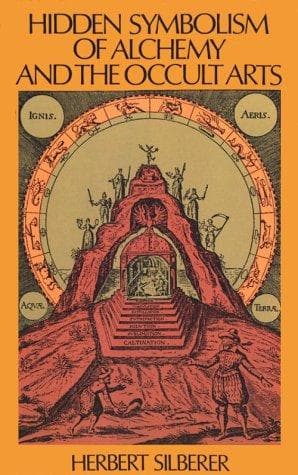
Hidden Symbolism of Alchemy and the Occult ArtsSilberer, Herbert
Religion
Hidden Symbolism of Alchemy and the Occult Arts
Silberer, Herbert
Alchemy; Society of Rosicrucians; Symbolism (Psychology)
Most noticeable is the complete and sudden change of place. The wanderer,
as I will hereafter call the narrator of the parable, sees himself
immediately transported from the place near the lion’s den to the top of a
wall, and does not know how he has come there. Later he comes down just as
suddenly. And in still other parts of the story there occurs just as rapid
changes of scene as one is accustomed to in dreams. Characteristic also is
the fact that objects change or vanish; the shift of scene resembles also,
as often in a dream, a complete transformation. Thus, for instance, as
soon as the wanderer has left the wall, it vanishes without leaving a
trace, as if it had never been. A similar change is also required in the
garden scene where, instead of the previously observed enclosing-wall, a
low hedge appears in a surprising manner.
Further, we are surprised by instances of knowledge without perception.
Often in a dream one knows something without having experienced it in
person. We simply know, without knowing how, that in such a house
something definite and full of mystery has happened; or we know that this
man, whom we see now for the first time, is called so and so; we are in
some place for the first time but know quite surely that there must be a
fountain behind that wall to which for any reason we have to go, etc. Such
unmediated knowledge occurs several times in the parable. In the beginning
of the narrative the wanderer, although a stranger, knows that the lovely
meadow is called by its inhabitants Pratum felicitatis. He knows
intuitively the name of one of the men unknown to him. In the garden scene
he knows, although he has noticed only the young men, that some young
women (whom on account of the nature of the place he cannot then see) are
desirous of going into the garden to these young men. One might say that
all this is merely a peculiarity of the representation inasmuch as the
author has for convenience, or on account of lack of skill, or for
brevity, left out some connecting link which would have afforded us the
means of acquiring this unexplained knowledge. The likeness to the dream
therefore would in that case be inadmissible. To this objection it may be
replied, that the dream does exactly like the author of the parable. Our
study is chiefly concerned with the product of the fancy and forces us to
the observation (whatever may be the cause of it) that the parable and the
dream life have certain “peculiarities of representation” in common.
Public-domain text, read in full here on John Shaqi.
Reviews
Reviews
No reviews yet
Be the first to share your thoughts on this work.
Join the Discussion
Join the discussion
Sign in to leave a comment or review.
Sign InorCreate an account