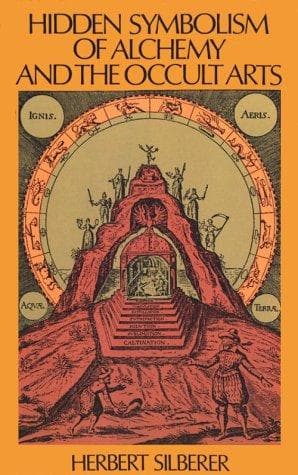
Hidden Symbolism of Alchemy and the Occult Arts — John Shaqi
Hidden Symbolism of Alchemy and the Occult ArtsSilberer, Herbert
Religion
Hidden Symbolism of Alchemy and the Occult Arts
Silberer, Herbert
Alchemy; Society of Rosicrucians; Symbolism (Psychology)
A nearly exact formula for the dream has been contributed by Freud and
Rank, “On the foundation and with the help of repressed infantile sexual
material, the dream regularly represents as fulfilled actual wishes and
usually also erotic wishes in disguised and symbolically veiled form.”
(Jb.; ps. F., p. 519, and Trdtg., p. 117.) In this formula the wish
fulfillment, following Freud’s view, is preponderant, yet it would appear
to me that it is given too exclusive a rôle in the (chiefly affective)
background of the dream. An important point is the infantile in the dream,
in which connection we must mention the Regression.
Regression is a kind of psychic retrogression that takes place in manifold
ways in the dream (and related psychic events). The dream reaches back
towards infantile memories and wishes. [Sometimes this is already
recognizable in the manifest dream content. Usually, however, it is first
disclosed by psychoanalysis. Strongly repressed, and therefore difficult
of access, is this infantile sexual material. On the infantile forms of
sexuality, see Freud, “Three Contributions to Sexual Theory.”] It reaches
back also from the complicated and completed to a more primitive function,
from abstract thought to perceptual images, from practical activity to
hallucinatory wish fulfillment. [The latter with especial significance in
the convenience dreams. We fall asleep, for instance, when thirsty, then
instead of reaching for the glass of water, we dream of the drink.] The
dreamer thus approaches his own childhood, as he does likewise the
childhood of the human race, by reaching back for the more primitive
perceptual mode of thought. [On the second kind of regression the Zurich
psychiatrist, C. G. Jung, has made extraordinary interesting revelations.
His writings will further occupy our attention later.]
Nietzsche writes (“Menschliches, Allzumenschliches”), “In sleep and in
dreams we pass through the entire curriculum of primitive mankind.... I
mean as even to-day we think in dreams, mankind thought in waking life
through many thousand years; the first cause that struck his spirit in
order to explain anything that needed explanation satisfied him and passed
as truth. In dreams this piece of ancient humanity works on in us, for it
is the germ from which the higher reason developed and in every man still
develops. The dream takes us back into remote conditions of human culture
and puts in our hand the means of understanding it better. The dream
thought is now so easy because, during the enormous duration of the
evolution of mankind we have been so well trained in just this form of
cheap, phantastic explanation by the first agreeable fancy. In that
respect the dream is a means of recovery for the brain, which by day has
to satisfy the strenuous demands of thought required by the higher
culture.” (Works, Vol. II, pp. 27 ff.)
Public-domain text, read in full here on John Shaqi.
Reviews
Reviews
No reviews yet
Be the first to share your thoughts on this work.
Join the Discussion
Join the discussion
Sign in to leave a comment or review.
Sign InorCreate an account