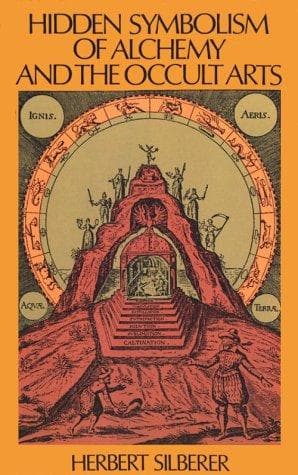
Hidden Symbolism of Alchemy and the Occult ArtsSilberer, Herbert
Religion
Hidden Symbolism of Alchemy and the Occult Arts
Silberer, Herbert
Alchemy; Society of Rosicrucians; Symbolism (Psychology)
If we remember that the explanation of nature and the philosophizing of
unschooled humanity is consummated in the form of myths, we can deduce
from the preceding an analogy between myth making and dreaming. This
analogy is much further developed by psychoanalysis. Freud blazes a path
with the following words: “The research into these concepts of folk
psychology [myths, sagas, fairy stories] is at present not by any means
concluded, but it is apparent everywhere from myths, for instance, that
they correspond to the displaced residues of wish phantasies of entire
nations, the dreams of ages of young humanity.” (Samml. kl. Lehr. II, p.
205.) It will be shown later that fairy stories and myths can actually be
subjected to the same psychologic interpretation as dreams, that for the
most part they rest on the same psychological motives (suppressed wishes,
that are common to all men) and that they show a similar structure to that
of dreams.
Abraham (Traum und Mythus)(1) has gone farther in developing the
parallelism of dream and myth. For him the myth is the dream of a people
and a dream is the myth of the individual. He says, e.g., “The dream is
(according to Freud) a piece of superseded infantile, mental life” and
“the myth is a piece of superseded infantile, mental life of a people”;
also, “The dream then, is the myth of the individual.” Rank conceives the
myths as images intermediate between collective dreams and collective
poems. “For as in the individual the dream or poem is destined to draw off
unconscious emotions that are repressed in the course of the evolution of
civilization, so in mythical or religious phantasies a whole people
liberates itself for the maintenance of its psychic soundness from those
primal impulses that are refractory to culture (titanic), while at the
same time it creates, as it were, a collective symptom for taking up all
repressed emotion.” (Inz-Mot., p. 277. Cf. also Kunstl., p. 36.)
Public-domain text, read in full here on John Shaqi.
Reviews
Reviews
No reviews yet
Be the first to share your thoughts on this work.
Join the Discussion
Join the discussion
Sign in to leave a comment or review.
Sign InorCreate an account