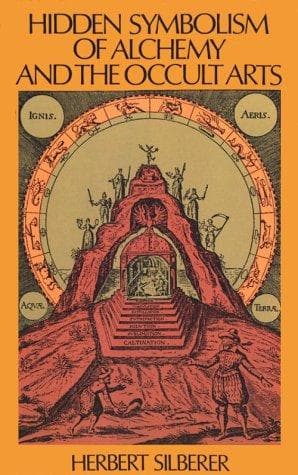
Hidden Symbolism of Alchemy and the Occult ArtsSilberer, Herbert
Religion
Hidden Symbolism of Alchemy and the Occult Arts
Silberer, Herbert
Alchemy; Society of Rosicrucians; Symbolism (Psychology)
I have just used a figure, “Let us follow him into his forest.” This is
worthy of notice. I mean, of course, that we betake ourselves into his
world of imagination and live through his dreams with him. We leave the
paths of everyday life, in order to rove in the jungle of phantasy. If we
remember rightly, the wanderer used the same metaphor at the beginning of
his narrative. He comes upon a thicket in the woods, loses the usual
path.... He, too, speaks figuratively. Have we almost unaware, in making
his symbolism our own, partially drawn away the veil from his mystery? It
is a fact confirmed by many observations [Cf. my works on threshold
symbolism—Schwellensymbolik, Jahrb. ps. F. III, p. 621 ff., IV, p. 675
ff.] that in hypnagogic hallucinations (dreamy images before going to
sleep), besides all kinds of thought material, the state of going to sleep
also portrays itself in exactly the same way that in the close of a dream
or hypnotic illusions on awakening, the act of awakening is pictorially
presented. The symbolism of awakening brings indeed pictures of leave
taking, departing, opening of a door, sinking, going free out of a dark
surrounding, coming home, etc. The pictures for going to sleep are
sinking, entering into a room, a garden or a dark forest.
The fairy story also used the same forest symbol. Whether on sinking into
sleep I have the sensation of going into a dark forest or whether the hero
of the story goes into a forest (which to be sure has still other
interpretations), or whether the wanderer in the parable gets into a
tangle of underbrush, all amounts to the same thing; it is always the
introduction into a life of phantasy, the entrance into the theater of the
dream. The wanderer, if he had not chosen for his fairy tale the first
person, could have begun as follows: There was once a king whose greatest
joy was in the chase. Once as he was drawn with his companions into a
great forest, and was pursuing a fleet stag, he was separated from his
followers, and went still further from the familiar paths, so that finally
he had to admit that he had lost his way. Then he went farther and farther
into the woods until he saw far off a house....
The wanderer comes through the woods to the Pratum felicitatis, the Meadow
of Felicity, and there his adventures begin. Here, too, our symbolism is
maintained; by sleeping or the transition to revery we get into the dream
and fairy tale realm, a land to which the fulfillment of our keenest
wishes beckons us. The realm of fairy tales is indeed—and the
psychoanalyst can confirm this statement—a Pratum felicitatis, in spite of
all dangers and accidents which we have there to undergo.
The dream play begins and the interpretation, easy till now, becomes more
difficult. We shall hardly be able to proceed in strictly chronological
order. The understanding of the several phases of the narrative does not
follow the sequence of their events. Let us take it as it comes.
Public-domain text, read in full here on John Shaqi.
Reviews
Reviews
No reviews yet
Be the first to share your thoughts on this work.
Join the Discussion
Join the discussion
Sign in to leave a comment or review.
Sign InorCreate an account