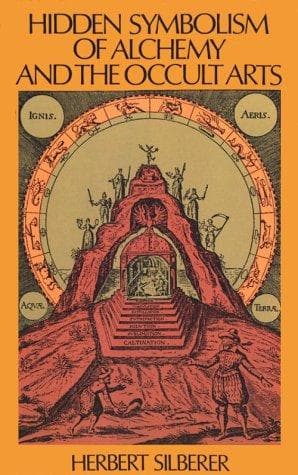
Hidden Symbolism of Alchemy and the Occult ArtsSilberer, Herbert
Religion
Hidden Symbolism of Alchemy and the Occult Arts
Silberer, Herbert
Alchemy; Society of Rosicrucians; Symbolism (Psychology)
The third is the conclusions from the peculiarities of structure of the
dream (myth, fairy tale) itself. In dreams and still more significantly in
the more widely cast works of the imagination creating in a dream-like
manner, as e.g., in myths and fairy tales, one generally finds motives
that are several times repeated in similar stories even though with
variations and with different degrees of distinctness. [Let this not be
misunderstood. I do not wish to revive the exploded notion that myths are
merely the play of a fancy that requires occupation. My position on the
interpretation of myths will be explained in Part I. of the synthetic
part.] It is then possible by the comparison of individual instances of a
motive, to conclude concerning its true character, inasmuch as one, as it
were, completes in accordance with their original tendency the lines of
increasing distinctness in the different examples, and thus—to continue
the geometric metaphor—one obtains in their prolongations a point of
intersection in which can be recognized the goal of the process toward
which the dream strives, a goal, however, that is not found in the dream
itself but only in the interpretation.
We shall employ the three methods of interpretation conjointly. After all
we shall proceed exactly as psychoanalysis does in interpretation of
folk-lore. For in this also there are no living authors that we can call
and question. We have succeeded well enough, however, with the derived
methods. The lack of an actual living person will be compensated for in a
certain sense by the ever living folk spirit and the infinite series of
its manifestations (folk-lore, etc.). The results of this research will
help us naturally in the examination of our parable, except in so far as I
must treat some of the conclusions of psychoanalysis with reserve as
problematic.
Let us now turn to the parable. Let us follow the author, or as I shall
call him, the wanderer, into his forest, where he meets his extraordinary
adventures.
Public-domain text, read in full here on John Shaqi.
Reviews
Reviews
No reviews yet
Be the first to share your thoughts on this work.
Join the Discussion
Join the discussion
Sign in to leave a comment or review.
Sign InorCreate an account