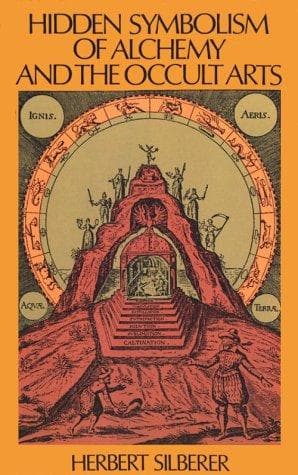
Hidden Symbolism of Alchemy and the Occult ArtsSilberer, Herbert
Religion
Hidden Symbolism of Alchemy and the Occult Arts
Silberer, Herbert
Alchemy; Society of Rosicrucians; Symbolism (Psychology)
Again in the course of the next sections (9-11) there are obstacles. There
a wall is set up against the wanderer. On account of that he has, in order
to gain entrance for the maidens into the company in the garden, to go a
long way round. Arriving at the door, he finds it locked and is afraid
that the people standing about will prevent his entrance or laugh at him.
But the first difficulty is barely removed, by the magic opening of the
first gate, when the now familiar change from the anxiety phase to the
fulfillment phase occurs. The wanderer traverses the corridor without
trouble but his eyes glance ahead of him and he sees through the still
closed door, as if it were glass, into the garden. What result has this
success over the difficulties yielded him? Where is the usual white and
red reward? We do not have to look long. In Sec. 11 it is recorded, “When
I had passed beyond the little garden [in the center of the larger garden]
and was going to the place where I was to help the maidens, behold, I was
aware that instead of the wall, a low hurdle stood there, and there went
by the rose garden, the most beautiful maiden arrayed in white satin with
the most stately youth who was in scarlet, each giving arm to the other,
and carrying in their hands many fragrant roses. ‘This, my dearest
bridegroom,’ said she, ‘has helped me over and we are now going out of
this lovely garden into our chamber to enjoy the pleasures of love.’ ”
Here the parallel with the fairy tale is complete, and reveals the
characteristic of the prize that rewards him. The red and the white reveal
themselves as man and woman, and the last aim is, as the just quoted
passage clearly shows, and the further course of the narrative fully
indicates, the sexual union of both. Even the rest of the fairy tale
prizes are not lacking—kingdoms, riches, happiness. And if they are not
dead they are still living.... The narrative has yielded a complete
fulfillment of wishes; the longing for love and power has attained its
end. That the wanderer does not experience the acquired happiness
immediately in his own person, but that the representation of happy love
is in the most illustrative manner developed in the union of two other
persons, is naturally a peculiarity of the narration. It is found often
enough in dreams. The ego of the dreamer is in such a case replaced by a
“split-off” person, through whom the dream evokes its dramatic pageantry.
It is as if the parable tried to say the hero has won his happy love
through struggle; two are, however, needful for love, a man and a woman,
so let us quickly create a pair. Apart from the fact that the reward must
evidently fall to the hero who has won it, the identity of the wanderer
with the king in the parable is abundantly demonstrated, even if somewhat
paraphrased. The secret of the dramatizing craft of the narrative is most
clearly exposed in the conclusion of Sec. 11, where the elders, with the
Public-domain text, read in full here on John Shaqi.
Reviews
Reviews
No reviews yet
Be the first to share your thoughts on this work.
Join the Discussion
Join the discussion
Sign in to leave a comment or review.
Sign InorCreate an account