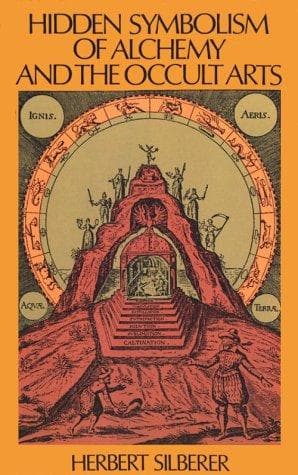
Hidden Symbolism of Alchemy and the Occult ArtsSilberer, Herbert
Religion
Hidden Symbolism of Alchemy and the Occult Arts
Silberer, Herbert
Alchemy; Society of Rosicrucians; Symbolism (Psychology)
letter of the faculty in their hands, reveal to the wanderer that he must
marry the woman he has taken, which he furthermore cheerfully promises
them to do.
So far all would be regular and we might think, on superficial
examination, that the psychoanalytic solution of the parable was ended.
How far from being the case! We have interpreted only the upper stratum
and will see a problem show itself that invites us to press on into the
deeper layers of the phantasy fabric before us.
We have noticed that in the parable much, even the most important, is
communicated only by symbols and by means of allusions. Its previously
ascertained latent content [corresponding to the latent dream thoughts]
will in the manifest form be transcribed in different and gradually
diminishing disguises. Also a displacement (dream displacement) has taken
place. Now the dream or the imagination working in dreams does nothing
without purpose and even though according to its nature (out of “regard
for presentability”) it has to favor the visual in all cases, the tendency
toward the pictorial does not explain such a systematic series of
disguises and such a determinate tendency as that just observed by us. The
representation of the union of man and woman is strikingly paraphrased.
First as blood and bones—a type of intimate vital connection; they belong
to _one_ body, just as two lovers are one and as later the bridal pair
also melt into one body. Then as two kinds of roses that bloom on one
bush. The wanderer breaks the rose as the boy does the wild rose maiden.
And hardly is the veil of the previous disguise lifted, hardly have we
learned that the wanderer has taken a woman (Sec. 11), when the affair is
again hushed just as it is about to be dramatized (cf. Sec. 12), so that
apparently another enjoys the pleasures of love. This consequent
concealment must have a reason. Let us not forget the striking obstacles
which the wanderer experiences again and again and which we have not yet
thoroughly examined. The symbolism of the dream tells us that such
obstacles correspond to conflicts of the will. What kind of inner
resistance may it be that checks the wanderer at every step on his way to
happy love? We suspect that the examinations have an ethical flavor. This
appears to some extent in the right-left symbolism; then in the experience
at the mill, which we have not yet studied, where the wanderer has to pass
over a very narrow plank, the ethical symbolism of which will be discussed
later; and in the striking feeling of responsibility which the wanderer
has for the actions of the bridal pair in the crystal prison, which gives
us the impression that he had a bad conscience. Altogether we cannot doubt
that the dream—the parable—has endeavored, because of the censor, to
disguise the sexual experiences of the wanderer. We can be quite certain
that it will be said that the sexual as such will be forbidden by the
censor. That is, however, not the case.
Public-domain text, read in full here on John Shaqi.
Reviews
Reviews
No reviews yet
Be the first to share your thoughts on this work.
Join the Discussion
Join the discussion
Sign in to leave a comment or review.
Sign InorCreate an account