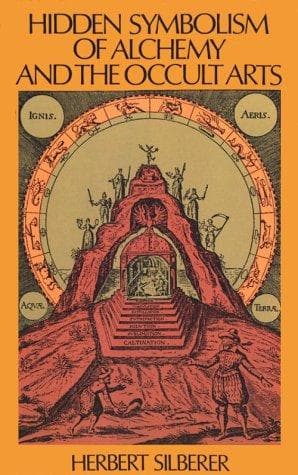
Hidden Symbolism of Alchemy and the Occult ArtsSilberer, Herbert
Religion
Hidden Symbolism of Alchemy and the Occult Arts
Silberer, Herbert
Alchemy; Society of Rosicrucians; Symbolism (Psychology)
The account is outspoken enough,
and not the least prudish; the bridal pair embrace each other naked,
penetrate each other and dissolve in love, melt in rapture and pain. Who
could ask more? Therefore the sexual act itself could not have been
offensive to the censor. The whole machinery of scrupulousness,
concealment and deterrent objects, which stand like dreadful watchmen
before the doors of forbidden rooms, cannot on the other hand be
causeless. So the question arises: What is it that the dream censor in the
most varied forms [lion, dangerous paths, etc.] has so sternly vetoed?
In the strawberry dream related in the preceding section, we have seen
that a paraphrase of the latent dream content appears at the moment when a
form of sexual intercourse, forbidden to the dreamer by the dream censor,
was to be consummated. (Homosexual intercourse.) Most probably in the
parable also there is some form of sexuality rejected by the censor. What
may it be? Nothing indicates a homosexual desire. We shall have to look
for another erotic tendency that departs from the normal. From several
indications we might settle upon exhibitionism. This is, as are almost all
abnormal erotic tendencies, also an element of our normal psychosexual
constitution, but it is, if occurring too prominently, a perversity
against which the censor directs his attacks. The incidents of the parable
that indicate exhibitionism are those where the wanderer sees, through
locked doors (Sec. 10) or walls (Sec. 11), objects that can be interpreted
as sexual symbols. The miraculous sight corresponds to a transferred wish
fulfillment. The supposition that exhibitionism is the forbidden erotic
impulse element that we were looking for is, however, groundless, if we
recollect that these very elements appear most openly in the parable. In
Sec. 14 the wanderer has the freest opportunity to do as he likes. Still
the question arises, what is the prohibited tendency? No very great
constructive ability is required to deduce the answer. The wording of the
parable itself furnishes the information. In Sec. 14 we read, “Now I do
not know what sin these two have committed except that although they were
brother and sister they were so united in love that they could not again
be separated and so, as it were, required to be punished for incest.” And
in another passage (Sec. 13), “After our bridegroom ... with his dearest
bride ... came to the age of marriage, they both copulated at once and I
wondered not a little that this maiden, that yet was supposed to be the
bridegroom’s mother, was still so young.”
Public-domain text, read in full here on John Shaqi.
Reviews
Reviews
No reviews yet
Be the first to share your thoughts on this work.
Join the Discussion
Join the discussion
Sign in to leave a comment or review.
Sign InorCreate an account