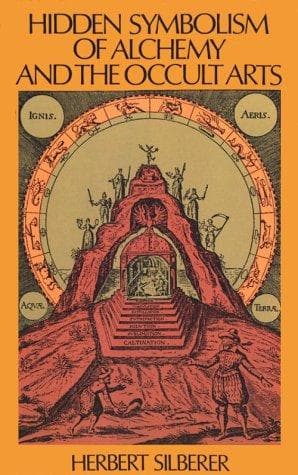
Hidden Symbolism of Alchemy and the Occult ArtsSilberer, Herbert
Religion
Hidden Symbolism of Alchemy and the Occult Arts
Silberer, Herbert
Alchemy; Society of Rosicrucians; Symbolism (Psychology)
The critical phase of the parable begins in the 11th section. The elders
consult over a letter from the faculty. The wanderer notices that the
contents concern him and asks, “Gentlemen, does it have to do with me?”
They answer, “Yes, you must marry your woman that you have recently
taken.” Wanderer: “That is no trouble; for I was, so to speak, born [how
subtle!] with her and brought up from childhood with her.” Now the secret
of the incest is almost divulged. But it is at once effectually retracted.
In Sec. 12 we read, “So my previous trouble and toil fell upon me and I
bethought myself that from strange causes [these strange causes are the
dream censor who, ruling in the unconscious, effects the displacements
that follow], it cannot concern me but another that is well known to me
[in truth a well-known other]. Then I see our bridegroom with his bride in
the previous attire going to that place ready and prepared for copulation
and I was highly delighted with it. For I was in great anxiety lest the
affair should concern me.” The anxiety is quite comprehensible. It is just
on account of its appearance that the displacement from the wanderer to
the other person takes place. Further in Sec. 13: “Now after ... our
bridegroom ... with his dearest bride ... came to the age of marriage [The
aim with which the censor performs his duties and effects the dream
displacement is, says Freud (Trdtg., p. 193), ‘to prevent the development
of anxiety or other form of painful affect’.] they both copulated ... and
I wondered not a little that this maiden, that was supposed to be actually
the _mother_ of the bridegroom, was still so young....” Now when the
transfer has taken place, the thought of its being the mother is hazarded;
whereas formerly a mere suggestion of a sister had been offered. Section
14 explicitly mentions incest and even arranges the punishment of the
guilt. In this form the matter can, of course, be contemplated without
troubling the conscience or being further represented pictorially.
Public-domain text, read in full here on John Shaqi.
Reviews
Reviews
No reviews yet
Be the first to share your thoughts on this work.
Join the Discussion
Join the discussion
Sign in to leave a comment or review.
Sign InorCreate an account