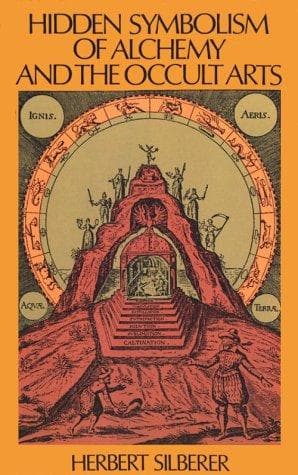
Hidden Symbolism of Alchemy and the Occult ArtsSilberer, Herbert
Religion
Hidden Symbolism of Alchemy and the Occult Arts
Silberer, Herbert
Alchemy; Society of Rosicrucians; Symbolism (Psychology)
The sister, alternating in the narrative with the mother, is only a
preliminary to the latter. As we find that the Œdipus complex [Rather an
attenuation, which occurs frequently, not merely in dream psychology, but
also in modern mythology.] is revived in the parable, let us bring the
latter into still closer relation with the fairy tales and myths to which
we have compared it. The woman sought and battled for by the hero appears,
in its deeper psychological meaning, always to be the mother. The
significance of the incest motive has been discovered on the one hand by
the psychoanalysts (in particular Rank, who has worked over extensive
material), on the other by the investigators of myths. That many modern
mythologists lay most stress in this discovery upon the astral or
meteorological content and do not draw the psychological conclusions is
another matter that will be discussed later. But in passing it may be
noted that the correspondence in the discovered material (motives) is the
more remarkable as it resulted from working in the direction of quite
different purposes.
It is now time to examine the details of the parable in conformity with
the main theme just stated and come to a definite interpretation.
Henceforward we may keep to a chronological order.
The threshold symbolism in the beginning of the parable has already been
given, also the obstacles that are indicative of a psychic conflict. We
might rest satisfied with that, yet a more complete interpretation is
quite possible, in which particular images are shown to be overdetermined.
The way is narrow, overgrown with bushes, and leads to the Pratum
felicitatis. That, according to a typical dream symbolism, is also a part
of the female body. The obstacles in the way we recognize as a recoil from
or impediment to incest; so it is evident that a definite female body,
namely that of the mother, is meant. The penetration leads to the Pratum
felicitatis, to blissful enjoyment. In fairy lore the sojourn in the
forest generally signifies death or the life in the underworld. Wilhelm
Muller, for example, writes, “As symbols of similar significance we have
the transformation into swans or other birds, into flowers, the exposure
in the forest, the life in the glass mountain, in a castle, in the
woods.... All imply death and life in the underworld.” The underworld is,
when regarded mythologically, not only the land where the dead go, but
also whence the living have come; thence for the individual, and in
particular for our wanderer, the uterus of the mother. It is significant
that the wanderer, as he strolls along, ponders over the fall of our first
parents and laments it. The fall of the parents was a sexual sin. That it
was incest besides, will be considered later. The son who sees in his
father his rival for his mother is sorry that the parents belong to each
other. A sexual offense (incest) caused the loss of paradise. The wanderer
enters the paradise, the Pratum felicitatis.
Public-domain text, read in full here on John Shaqi.
Reviews
Reviews
No reviews yet
Be the first to share your thoughts on this work.
Join the Discussion
Join the discussion
Sign in to leave a comment or review.
Sign InorCreate an account