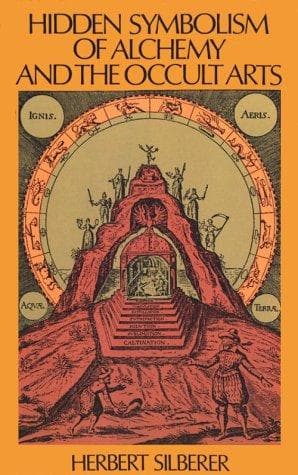
Hidden Symbolism of Alchemy and the Occult ArtsSilberer, Herbert
Religion
Hidden Symbolism of Alchemy and the Occult Arts
Silberer, Herbert
Alchemy; Society of Rosicrucians; Symbolism (Psychology)
[Garden of Joy, Garden of
Peace, Mountain of Joy, etc., are names of paradise. Now it is
particularly noteworthy that the same words can signify the beloved.
(Grimm, D. Mythol., II, pp. 684 ff., Chap. XXV, 781 f.)] The path thither
is not too rough for him (Sec. 2).
In Sec. 3 the wanderer enters his paradise (incest). He finds in the
father an obstacle to his relation with the mother. The elders (splitting
of the person of the father) will not admit him, forbid his entrance into
the college. He himself, the youth is already among them. The younger man,
whose name he knows without seeing his face, is himself. He puts himself
in the place of his father. (The other young man with the black pointed
beard may be an allusion to a quite definite person, intended for a small
circle of readers of the parable, contemporaries of the author. Either the
devil or death may be meant, yet I cannot substantiate this conjecture.)
In the fourth section the examinations begin. First the examination in the
narrower sense of the word. The paternal atmosphere of every examination
has already been emphasized in the passage from Freud quoted above. Every
examination, every exercise is associated with early impressions of
parental commands and punishments. Later (in the treatment of the lion)
the wanderer will turn out to be the questioner, whereas now the elders
are the questioners. In the relation between parent and child questions
play a part that is important from a psychological point of view.
Amazingly early the curiosity of the child turns toward sexual matters.
His desire to know things is centered about the question as to where
babies come from. The uncommunicativeness of the parents causes a
temporary suppression of the great question, which does not, however,
cease to arouse his intense desire for explanation. The dodging of the
issue produces further a characteristic loss of trust on the part of the
child, an ironic questioning, or a feeling that he knows better. The
knowing better than the questioning father we see in the wanderer. The
tables are turned. Instead of the child desiring (sexual) explanation from
the parents, the father must learn from the child (fulfillment of the wish
to be himself the father, as above). The elders are acquainted only with
figurative language (“Similitudines,” “Figmenta,” etc.); but the wanderer
is well informed in practical life, in experience he is an adept. As a
fact, parents in their indefiniteness about the question, Where do babies
come from? give a figurative answer (however appropriate it may be as a
figure of speech) in saying that the stork brings them, while the child
expects clear information (from experience). On the propriety of the
picturesque information that the stork brings the babies out of the water
we may note incidentally the following observations of Kleinpaul. The
fountain is the mother’s womb, and the red-legged stork that brings the
Public-domain text, read in full here on John Shaqi.
Reviews
Reviews
No reviews yet
Be the first to share your thoughts on this work.
Join the Discussion
Join the discussion
Sign in to leave a comment or review.
Sign InorCreate an account