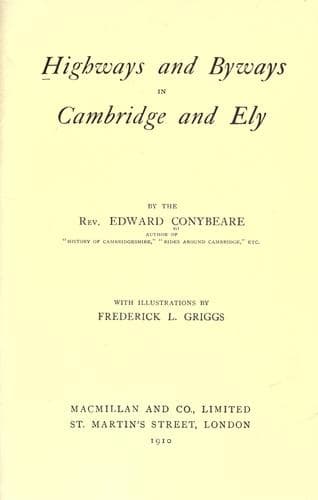
Highways and Byways in Cambridge and ElyConybeare, John William Edward
History
Highways and Byways in Cambridge and Ely
Conybeare, John William Edward
Cambridgeshire (England) -- Description and travel; Isle of Ely (England) -- Description and travel
Three miles on, we come to the furthest outpost of the East Anglian
uplands, the little market town of Soham, situated on an almost
isolated peninsula of the chalk, which here runs out into the fen, and
upon the very borders[129] of the Isle of Ely. The Cathedral is here a
conspicuous object, rising high upon its hill over the intervening
fen, and only five miles away. But Soham is associated with a yet
earlier development of local Christianity than Ely itself. Forty years
before St. Etheldreda founded her Abbey, one was here established by
St. Felix, "the Apostle of East Anglia." That title does not mean that
he was absolutely the first to preach the Gospel to the East English,
but the first whose work was permanent. For the introduction of the
Faith into these parts met with more than one set-back before it was
fairly established.
[Footnote 129: These borders are now marked only in the Ordnance maps.
The line runs right across the county from west to east, following the
West River (the ancient course of the Ouse), to its junction with the
Cam, and then almost straight eastward to the boundary of Suffolk,
along a water-course known as the "Bishop's Delph" (_i.e._, ditch,
from the verb _delve_).]
Within two years of the first coming of St. Augustine in 597 A.D.,
Redwald King of East Anglia, who had succeeded the earliest Christian
monarch, Ethelbert of Kent, in the dignity of Bretwalda,[130] followed
him also in seeking baptism. His Christianity, however, was of too
unconventional a type to be acceptable. Bede tells us how "in the same
temple he had an altar for the sacrifice of Christ, and a small one to
offer sacrifices unto devils." This attempt (made under the influence
of his heathen wife) was foredoomed to failure, and was followed by a
period of religious confusion, till Sigebert, his son, succeeded to
the throne. He had been an exile in France, where he had become "a
most Christian and learned man," under the influence of St. Felix, a
holy man of Burgundy, whose help he asked, on becoming King, "to cause
all his province to partake" of his religion.
[Footnote 130: This title implied a vague Primacy amongst the various
Anglo-Saxon monarchs, conferred, by as vague a recognition on their
part, upon him who was for the time the most powerful amongst them.
But though vague it was far from unreal. We find Ethelbert's
protection enabling St. Augustine to preach all over England. Indeed
the name (which etymologically signifies merely Broad Wielder) very
early got to be regarded as meaning Wielder of Britain.]
[Illustration: _Fordham._]
Public-domain text, read in full here on John Shaqi.
Reviews
Reviews
No reviews yet
Be the first to share your thoughts on this work.
Elsewhere in the archive
Join the Discussion
Join the discussion
Sign in to leave a comment or review.
Sign InorCreate an account