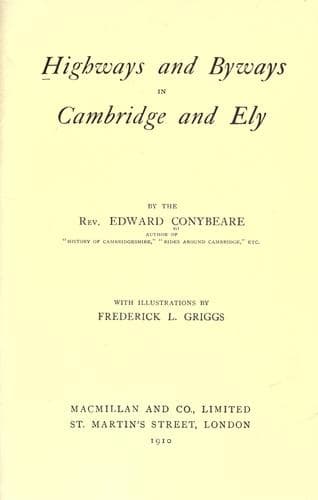
Highways and Byways in Cambridge and ElyConybeare, John William Edward
History
Highways and Byways in Cambridge and Ely
Conybeare, John William Edward
Cambridgeshire (England) -- Description and travel; Isle of Ely (England) -- Description and travel
From Hildersham the road goes on to Linton, a mile or so further;
while the two places are also connected by a specially pleasant
footpath, starting from a fine old smithy, and so through the meadows
by the clear trout-stream, and past the yews and thorn-trees of the
moated grange of "Little Linton," while above rises (to nearly four
hundred feet, a proud height in Cambridgeshire) the appropriately
named Furze Hill, with some real gorse patches (also a proud
distinction in Cambridgeshire) upon its ridge.
Before we reach Linton we cross the famous "Clapper" stile, which can
best be described as formed by three huge sledge-hammers (of wood)
with exceptionally long shanks, hinged near the head to an upright
post, each about a foot above the next. Normally the three
hammer-heads rest upon one another and look like a single post (about
a foot from the first); but, on attempting to cross, the shanks (the
ends of which are _not_ fastened but slide in a grooved post at their
side of the stile) yield to our weight, the heads fly apart, and, when
we are over, come together again with the "claps" whence the name of
the stile is derived. How old this curious device is does not appear,
but it is here immemorial. An effective sketch of this stile is given
by Dr. Wherry, in his "Notes from a Knapsack."
Linton is a tiny town, smaller than sundry villages, but obviously not
a village, with a long street of undetached houses (duly lighted)
swinging down the slopes on either side the little river. There is a
fine Perpendicular church, with some Norman work remaining in it, and
a good tower, on the top of which an Ascension Day service is annually
held. Against a wall are suspended two fire-hooks (much lighter than
the one at St. Benet's, Cambridge) for the destruction of burning
houses. (See note on page 38).
The main road here goes on, to pass out of Cambridgeshire into
Suffolk, a few miles further, at the upland village of Horseheath,
with its picturesque old-world village green on the hillside. The
church here has a fine fourteenth century brass to Sir John de
Argentine (a name familiar to readers of Sir Walter Scott, in the
"Lord of the Isles")[151] and some notable monuments, somewhat
knocked about, presumably by Dowsing, who records how he here "brake
down four pictures of the prophets Ezekiel, Daniel, Zephaniah, and
Malachi," besides other damage.
[Footnote 151: Local antiquarian research, however, considers that the
name is more probably Audley. One of the Audleys of Horseheath (who
were in no way connected with the Reformation Audleys, of Audley End
and Magdalene College), distinguished himself at the battle of
Poictiers.]
Public-domain text, read in full here on John Shaqi.
Reviews
Reviews
No reviews yet
Be the first to share your thoughts on this work.
Elsewhere in the archive
Join the Discussion
Join the discussion
Sign in to leave a comment or review.
Sign InorCreate an account