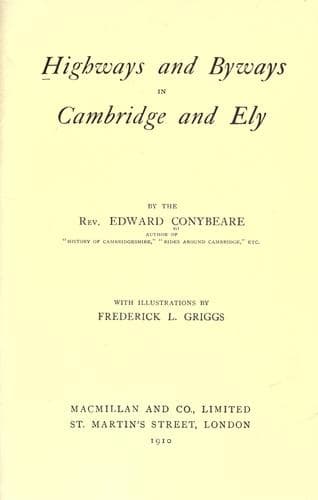
Highways and Byways in Cambridge and ElyConybeare, John William Edward
History
Highways and Byways in Cambridge and Ely
Conybeare, John William Edward
Cambridgeshire (England) -- Description and travel; Isle of Ely (England) -- Description and travel
But a more interesting road from Linton is that which continues along
the Bourne Valley, and leads, not into Suffolk, but into Essex, which
is here bounded by that stream. A mile beyond the town we pass Barham
Hall, now a farm-house, but of old a Priory of the same Order that we
found at Isleham,[152] a Cell (or Colony) of the Abbey of St. Jacutus
de Insula in Brittany. Another mile brings us to Bartlow, where, hard
by the church, stand the three huge tumuli from which the name of the
village is said to be derived. How they came to exist is an unsolved
problem. Remains found in them, when excavated in 1835, were reported
to be Roman, but the science of archaeology was then in its infancy,
and this report can hardly outweigh the wholly un-Roman appearance of
the "Hills," as they are locally called. They look far more like
British or Scandinavian work; but, indeed, three such mounds so close
together are not found elsewhere, of any age.
[Footnote 152: See p. 183.]
The little church has an ancient fresco of St. Christopher, placed, as
usual, opposite the entrance. For this Saint, by virtue of the legend
which tells how he carried Christ over a river,[153] was in mediaeval
times regarded as a special example for Christians in their going out
and their coming in; to whom, therefore, was due their first and last
thought in passing the doorway. More noteworthy is the Saxon tower,
with its walls no less than six feet in thickness. For in this it is
quite possible that we may have a part of the very "minster of stone
and lime" raised by Canute in memory of his crowning victory over
Edmund Ironside at Assandun.
[Footnote 153: The legend ran that St. Christopher was a giant heathen
who heard of Christ and desired to serve Him. Enquiring how he could
do this, he was told to devote himself to deeds of charity, which he
did by carrying pilgrims over a dangerous ford. Finally, a child whom
he thus transported proved to be Christ Himself, whence he gained the
name of Christopher (the Christ-bearer).]
The location of that most dramatic of English battles, fought in the
year 1016, is hotly disputed amongst historians; but there is much to
be said for the early view which identifies Assandun with Ashdon in
Essex, hard by Bartlow. For ten miserable years, under Ethelred the
Unready, England had been ground in the dust, deeper and ever deeper,
beneath the heel of the invading Dane. Year by year the degrading
tribute wherewith she strove to buy off the foe had gone up by leaps
and bounds. All hope seemed dead, when the accession of a hero to the
throne roused the harried and exhausted nation into one last
convulsive effort for freedom. Six times in as many months did Edmund
of England and Canute of Denmark clash in battle. Five of these fields
were indecisive, and then, on St. Luke's Day, 1016, the champions met
once more at Assandun, perhaps on the slope still known as Bartlow
End.
Public-domain text, read in full here on John Shaqi.
Reviews
Reviews
No reviews yet
Be the first to share your thoughts on this work.
Elsewhere in the archive
Join the Discussion
Join the discussion
Sign in to leave a comment or review.
Sign InorCreate an account