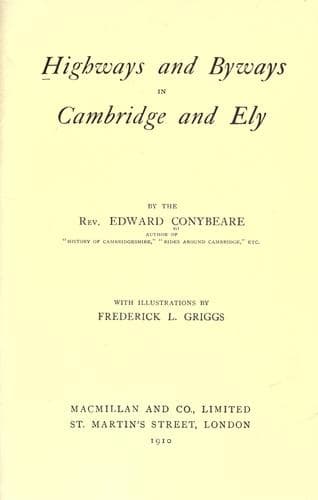
Highways and Byways in Cambridge and ElyConybeare, John William Edward
History
Highways and Byways in Cambridge and Ely
Conybeare, John William Edward
Cambridgeshire (England) -- Description and travel; Isle of Ely (England) -- Description and travel
Cherry Hinton itself is not yet absorbed by Cambridge, and remains a
bright spacious village, with a rarely beautiful church. The exquisite
Early English chancel is lighted on either side by four couplets of
lancet windows, in ideal proportion, while five equally ideal lancets
serve for an East window. Both walls have an arcading of cinque-foil
pattern; and the double piscina and the graduated sedilia are of no
less merit. All this loveliness is within a fine oaken screen of the
fifteenth century, and the rest of the church is not unworthy of it.
The great quarry, whence the "clunch" of which the church is mainly
built was drawn, is a conspicuous object on the hill-side above the
village; and above that again, equally conspicuous, is the reservoir
of the Cambridge Water-works, looking like a redoubt, on the summit of
the slope. At the foot clear springs break out from the chalk, which
are also utilised to supply the town.
Close to the reservoir there is an actual fortification, an ancient
earthwork, known as the War Ditches, which the researches of Professor
Hughes have shown to be of British date.[154] At the bottom of the
fosse he discovered rough British pottery along with the bones of
domestic animals, and above these a layer of disjointed human
skeletons of both sexes and all ages, apparently due to a general
massacre, in some prehistoric struggle, of men, women, and children,
whose corpses were hurled over the parapet. Above these again came
Romano-British remains. From this earthwork the line of an ancient
dyke, now called Warstead Street, may be traced to the East Anglian
heights near Horseheath.
[Footnote 154: Hughes' _Geography of Cambs_, p. 139.]
Till the nineteenth century the fields between Cherry Hinton and
Cambridge were bright with the purple flowers of the saffron crocus,
which was grown, as it was by the ancient Greeks and Romans, for
medical use and for dyeing purposes. Its cultivation may very probably
have been introduced into Britain by the Romans. The saffron here
grown was considered the best in Europe, and fetched no less than
thirty shillings a pound. But its use, after so many centuries,
suddenly went out of fashion, and the plant is now wholly extinct in
Cambridgeshire.[155]
[Footnote 155: _Ibid._ p. 96.]
Public-domain text, read in full here on John Shaqi.
Reviews
Reviews
No reviews yet
Be the first to share your thoughts on this work.
Elsewhere in the archive
Join the Discussion
Join the discussion
Sign in to leave a comment or review.
Sign InorCreate an account