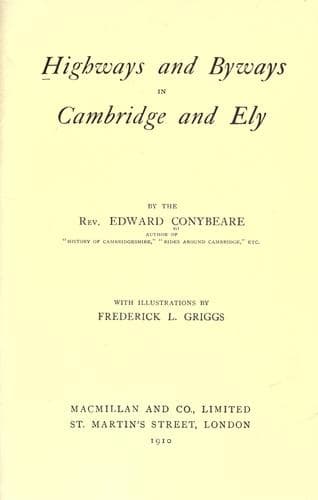
Highways and Byways in Cambridge and ElyConybeare, John William Edward
History
Highways and Byways in Cambridge and Ely
Conybeare, John William Edward
Cambridgeshire (England) -- Description and travel; Isle of Ely (England) -- Description and travel
From Cherry Hinton Church a green lane leads to Teversham, a short
mile distant, but, except for pedestrians, more easily approached from
the Newmarket Road. The church here is a pretty little structure,
mainly Early English, with curious oval clerestory windows, and a nice
Perpendicular screen. The octagonal pillars have floreated capitals.
Dowsing's record of his destructions here is of special interest,
inasmuch as the objects of his Protestant zeal were not, as usual,
relics of pre-Reformation Popery, but the newly painted devices of the
Laudian vicar, Dr. Wren (the Bishop of Ely and builder of Peterhouse
Chapel). They consisted of the name JESUS, "in big letters" no fewer
than eighteen times repeated, of those of the Three Persons of the
Blessed Trinity, and of texts from Scripture: "Let this mind be in you
which was also in Christ Jesus," and "O come let us worship and fall
down and kneel before the Lord our Maker." All these were "done out"
as "idolatries"!
From the springs at Cherry Hinton the furrow-drawn road (passing on
its way the County Lunatic Asylum) makes another bee-line of three
miles to Fulbourn. Here the church is of special interest. There are
no fewer than five mediaeval brasses, including one, almost life-size,
of Canon William de Fulburne, 1380, which is notable as being,
probably, the earliest known example of a priest vested in a cope.
This ecclesiastic was one of Edward the Third's chaplains. In a wooden
shrine on the north side of the chancel is a moribund effigy of John
Careway, vicar here in 1433. This is beneath a sept-foiled arch,
beside which is another strangely irregular arch over a sedile. There
is also the very unusual feature of a fourteenth century pulpit of
richly-carved oak.
The dedication of this church is as unusual. It is to St. Vigor, an
obscure sixth century bishop of Bayeux, who has only one other church
in England, at Stratton-on-the-Fosse in Somerset. Till late in the
eighteenth century there was a second church here in the same
churchyard, as at Swaffham Prior. This was All Saints', and was ruined
by the fall of its tower in 1766. The ruins were gradually stolen, the
wood going first, but it took ten years for the last of the bells to
disappear.
Public-domain text, read in full here on John Shaqi.
Reviews
Reviews
No reviews yet
Be the first to share your thoughts on this work.
Elsewhere in the archive
Join the Discussion
Join the discussion
Sign in to leave a comment or review.
Sign InorCreate an account