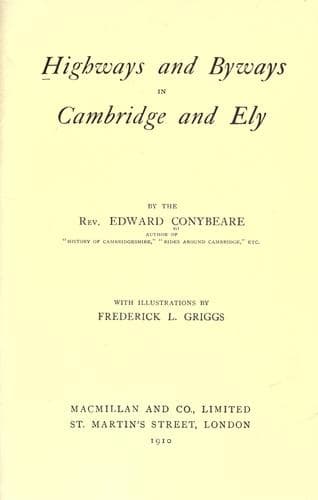
Highways and Byways in Cambridge and ElyConybeare, John William Edward
History
Highways and Byways in Cambridge and Ely
Conybeare, John William Edward
Cambridgeshire (England) -- Description and travel; Isle of Ely (England) -- Description and travel
Preceptories of the Order, as their branch Houses were called, were
found in every land, and not least in England, where they were so much
beloved that, when the rival Order of the Temple was suppressed, in
the fourteenth century, its property was made over to them. Here, at
Shingay, their establishment was a small one consisting of the
preceptor, two knights, and three priests, one of whom acted as Vicar
of Wendy. The gross income of the House was, in 1332 (as we know from
a Report still existing in the Record Office at Malta), L187 12s. 8d.,
equivalent to about L3,500 at the present value of money. Of this the
land (about 1,000 acres) brought in L71; the mills, houses, etc., L4
13s. 4d.; the work of the villains L38 10s. 0d.; and the Rectories of
Wendy and Sawston, which formed part of their endowment, L66 13s. 4d.
The rest was derived from the fees paid by visitors; for, by the rule
of the Order, the doors of the House were open to all comers. The
expenses of the year amounted to less than half the income, for they
lived frugally, their keep only coming to about L3 a week (in present
value) for the six inmates, besides servants and guests. Men servants
were paid at the rate of L12 a year (besides their keep), and each
knight was allowed the equivalent of L25 a year for clothing and
pocket-money. Thus a large sum was available for the war-chest of the
Order, and was annually forwarded to the headquarters at Jerusalem or
Rhodes.
One of their sources of income was a special privilege which is still
remembered in local tradition. Their House (like those of the
Templars) was exempt from every ban, even that of the Pope himself.
Thus, in the dismal days of King John, when England was placed under
an Interdict, when no rites of religion could be observed, and even
burial of the dead was forbidden, so that "you might see human bodies
lying everywhere about the fields unsepultured," Shingay shone out as
the one spot in the whole district where the consolations of religion
were still attainable. Here Mass continued to be said, here the
departed could still be laid in hallowed earth. And hither they were
brought from all sides. And thus it is that peasants may be found who
still tell how, at some far off, unknown period, those who, for some
forgotten, inexplicable reason, might not be buried like Christians in
their own churchyard, were spirited away by night in a "fairy-cart" to
Shingay, there to be committed in peace to the ground. This
"fairy-cart" is an echo of the word _feretorium_ (or bier on wheels),
in which the conveyance was actually effected.
[Illustration: _Rood Screen, Guilden Morden Church._]
Public-domain text, read in full here on John Shaqi.
Reviews
Reviews
No reviews yet
Be the first to share your thoughts on this work.
Elsewhere in the archive
Join the Discussion
Join the discussion
Sign in to leave a comment or review.
Sign InorCreate an account