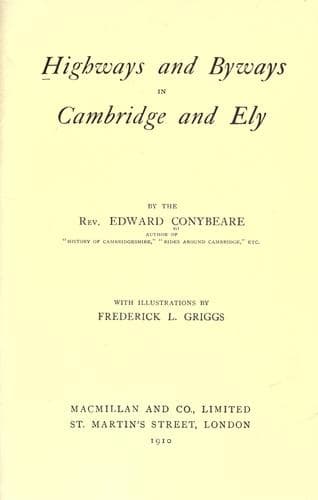
Highways and Byways in Cambridge and ElyConybeare, John William Edward
History
Highways and Byways in Cambridge and Ely
Conybeare, John William Edward
Cambridgeshire (England) -- Description and travel; Isle of Ely (England) -- Description and travel
L _s._ _d._
1 Cowl 1 0 0
1 Monk's Frock 5 10 0
1 Pellice[215] 3 0 0
1 Winter coat 4 10 0
1 Summer ditto 4 5 0
1 Shirt (?) 2 5 0
1 Pair of linen drawers 3 0 0
2 Pair boots[216] 2 5 0
1 Pair Gaiters and Slippers 1 5 0
1 "Wilkok"[217] 10 0
1 Counterpane 4 10 0
1 Coverlet 2 0 0
1 Blanket[218] 12 6
[Footnote 214: We find the monks complaining that the L300 a year
(equivalent to L9,000 now), to which the Abbey income sank in the
twelfth century would barely support forty monks. The best working
standard by which to ascertain how much money is worth in any given
age is the current day-wage of a labourer. In the fourteenth century
this was 1_d._; it is now 2_s._ 6_d._ Therefore money went thirty
times as far then as now.]
[Footnote 215: This was a cassock lined with wool. The word _surplice_
is derived from it, being an alb roomy enough to wear over a pellice.]
[Footnote 216: The boots were of soft leather rising nearly to the
knee.]
[Footnote 217: This was probably the head-covering which the monks of
Ely wore, by special licence from the Pope, "on account of the windy
situation of their church." The name may survive in our modern
"billy-cock."]
[Footnote 218: The blanket was 3-1/2 yards long, as blankets are
still.]
This was in the year 1334,[219] and is a fair average specimen of the
cost, which varied very little from year to year. Readers of Chaucer
will remember how comfortably, and even luxuriously, he represents his
monk in the Canterbury Tales as being dressed. The old garments of the
monks were, at the end of the year, returned to the Camerarius for
distribution amongst the poor.
[Footnote 219: It is given by Bishop Stubbs, in his _Historical
Memorials of Ely_.]
Each monk had to enter the convent provided with a pair of blankets,
garments of all kinds, bedding, towels, a bag for clothes for the
wash, a furred tunic, day and night boots, a silver spoon, and many
other articles. The novices had tablets hung round their necks on
which to write in pencil each breach of the rule as it was committed
lest it should be forgotten in the public confession of such formal
transgressions which every brother had to make at the daily Chapter.
These youths had also each to carry, in a pouch provided for the
purpose, a knife, a comb, a needle, and some thread.
Public-domain text, read in full here on John Shaqi.
Reviews
Reviews
No reviews yet
Be the first to share your thoughts on this work.
Elsewhere in the archive
Join the Discussion
Join the discussion
Sign in to leave a comment or review.
Sign InorCreate an account