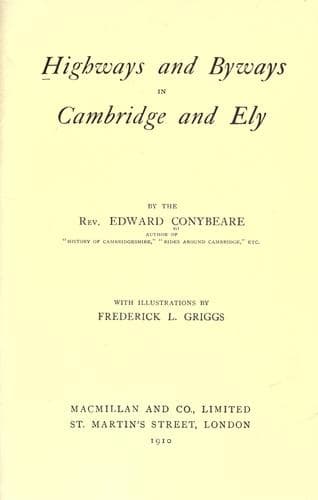
Highways and Byways in Cambridge and ElyConybeare, John William Edward
History
Highways and Byways in Cambridge and Ely
Conybeare, John William Edward
Cambridgeshire (England) -- Description and travel; Isle of Ely (England) -- Description and travel
A complete set of Cellerarius Rolls is preserved at Ely, and these
give a full account of the food in use in the monastery, with details
as to its cost; and it appears to have been both wholesome and
plentiful. Beef, mutton, venison, bacon, fowls, fish, butter,
vegetables, rice, and sugar were provided, and bread of five different
qualities. No less than 2,450 eggs were required for a single week's
consumption. There was an ample allowance of milk; but the principal
drink was beer, made in the brewhouse bequeathed to the convent by
Bishop Hugh de Balsham, and supplied, like the bread, in five
different qualities, the most inferior being known as "Skegman." All
the food was in charge of the Cellerarius and Granatarius, themselves
brethren of the monastery. The latter functionary was responsible for
the bread and the beer, as being both made from grain. Wine was only
produced at special festivals, and was almost wholly imported from
Bordeaux, Oporto, or Xeres in Andalusia; a trade still recorded in our
current words "port" and "sherry." For though vineyards were common in
mediaeval England (and notably at Ely, as the epitaph to Alan of
Walsingham reminds us), yet they very seldom produced drinkable wine,
and practically existed only to supply vinegar, a condiment much in
use for rendering dry fish less unpalatable.
The Benedictine Rule was strict in itself. The day began at 2 a.m.,
when every monk had to leave his bed for Mattins and Lauds, a Service
occupying two hours. Then came an hour during which he might return to
his bed,[220] to be waked again at 5 a.m., for Prime and Terce.[221]
Then followed the daily Chapter Meeting, when the work of the coming
day was apportioned, and the faults of the past day rebuked. This
ended, all had to attend Low Mass, and at eight o'clock High Mass,
which was over by ten. Then, and not till then, the monks partook of
the first meal of the day. For this they repaired to the refectory,
and on entering they paused and saluted with a profound bow the
crucifix, hanging over the High Table, and known to them as the
"Majestas." (This title was due to the phrase in the familiar hymn,
_Vexilla Regis_, "God reigneth from the tree."[222]) Their food was
eaten in silence while portions of Scripture were read aloud by one
of the brethren. He was bound to prepare this reading carefully, and
was directed to avoid all hurry, and to repeat any passage of special
note, in order that it might make the deeper impression on his
hearers. After this came study in the Cloisters, varied by a stroll in
the Burial Ground for meditation on mortality. At 3 p.m. they went
again to the church, to sing Vespers; at 5 p.m. came supper with the
same accompaniment as the morning meal; Compline followed; and then it
was bed-time. On some occasions the Rule was relaxed and the monks
were allowed to take part in quiet games, particularly at
Christmastide.
Public-domain text, read in full here on John Shaqi.
Reviews
Reviews
No reviews yet
Be the first to share your thoughts on this work.
Elsewhere in the archive
Join the Discussion
Join the discussion
Sign in to leave a comment or review.
Sign InorCreate an account