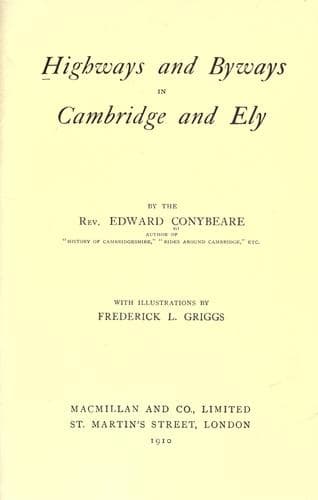
Highways and Byways in Cambridge and ElyConybeare, John William Edward
History
Highways and Byways in Cambridge and Ely
Conybeare, John William Edward
Cambridgeshire (England) -- Description and travel; Isle of Ely (England) -- Description and travel
[Footnote 220: The beds were stuffed with hay, which the Camerarius
was bound to change once a year, at the annual cleaning of the
dormitory.]
[Footnote 221: The remaining "Short" Offices were probably said, Sext
after High Mass, and Nones at mid-day (whence our word Noon).]
[Footnote 222: In this earliest type of crucifix Christ was royally
crowned and robed (as in the famous _Volto Santo_ at Lucca). See p.
288.]
Once in six weeks each monk had to undergo the _Minutio sanguinis_, or
blood-letting, supposed in those days to conduce to health; and this
drove him into the infirmary, where he had to spend about a week along
with a batch of his brethren undergoing the same treatment. This
custom, which sounds to us so unreasonable, tended at least to break
the monotony of monastic life. Those who could stand it all, and gain
good by it, must have been men of iron both in mind and body.
Such was the discipline through which those men had to pass who built
Ely Minster, and dwelt and worshipped there for close upon nine
hundred years. The "Liber Eliensis" tells us "There was one Rule for
all; the chief requirement was obedience, love of sacred worship, and
a full resolve to maintain the honour of God's House." In words that
form part of their Rule, they could say "We believe that the Divine
Presence exists everywhere, but above all when we attend Divine
Service."
In the year 1539 the Monastery was dissolved by Henry the Eighth, and
reconstituted as a Chapter of Dean and Canons. As we read this the
question forces itself upon our minds "What became of the monks thus
disbanded?" At Ely the monastery could, it is true, hold seventy
monks, but the full roll were seldom, if ever, in residence at one
time. After the Black Death (in 1349) the number fell to twenty-eight;
and in the year 1532, seven years before the monastery was dissolved,
there were only thirty-six monks on the spot, besides the Prior.
Father Gasquet, a most diligent searcher into the history of that
time, allows that, in spite of all his labour, "hardly any detail of
the subsequent lives of those ejected from the dismantled cloisters of
England is known to exist." It is, however, recorded that three of the
Ely monks, being noted as good choir men, received a pension of L8 a
year (equivalent to about L80 now) besides an office. But such traces
are scanty indeed; some monks who were priests were appointed to the
cure of souls; others lived on the pensions allotted to them which
were usually equivalent to about L50 a year, paid as a rule fairly and
punctually; some received on quitting the monastery a grant of money;
we hear that one band of monks went out into the world each with a sum
of twenty-six shillings and eightpence in his pocket (barely L15 at
the present value of money). Such was the fate of the inmates of the
Abbeys that submitted to the demands of the King, as did Ely under
Goodrich, the last of the Abbots. Where "voluntary surrender" was
Public-domain text, read in full here on John Shaqi.
Reviews
Reviews
No reviews yet
Be the first to share your thoughts on this work.
Elsewhere in the archive
Join the Discussion
Join the discussion
Sign in to leave a comment or review.
Sign InorCreate an account