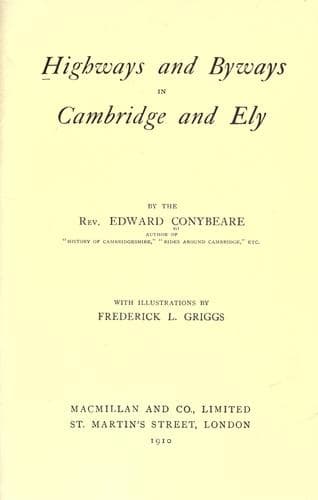
Highways and Byways in Cambridge and ElyConybeare, John William Edward
History
Highways and Byways in Cambridge and Ely
Conybeare, John William Edward
Cambridgeshire (England) -- Description and travel; Isle of Ely (England) -- Description and travel
refused, as it was by the Abbots of Glastonbury, Reading, Jervaulx,
and other Houses, on the ground that their monastery was "not theirs
to give," the monks were turned adrift without any provision
whatsoever for the future. Some fled to the Continent, others to
Scotland, while many died as the natural result of a sudden change in
their mode of life combined with privation and distress.
It is nearly four hundred years since all these changes befell Ely.
Many devoted men have during these long years filled the See, men of
mettle, of learning and piety. Among others we may mention Thomas
Thirlby, Bishop from 1554-1559 during the reign of Mary Tudor, who was
deposed under Elizabeth on refusing to take the oath of the royal
supremacy, "having declared that he would sooner die than consent to a
change of religion." For this he was imprisoned in the Tower for three
years, till a visitation of the plague led to his being sent from the
infected air of London to the purer atmosphere of Canterbury, as the
prisoner-guest of Archbishop Parker, under whose charge he remained
for seven years. His imprisonment does not appear to have been
rigorous, as far as physical comfort was concerned; but, with the
illiberality universal in those days, he was denied the consolations
of his religion; he might neither say nor hear Mass, he might read no
books except Protestant ones; he might write no letters, nor even
converse with anyone save under strict supervision. At Lambeth Palace
lodging was provided for him, till he died in the summer of 1570, and
was buried in the adjoining Parish Church.
In the reign of James the First, from 1609-1619, Ely had as her Bishop
Lancelot Andrewes, whose well-known Book of Devotions bears witness to
his piety. That he was also a man of culture is evident by his being
chosen to be one of the translators of the Bible.
In Matthew Wren, who was Bishop of Ely for twenty-nine years, from
1638-1667, we meet with another prisoner for his faith. Bishop Wren
was anti-puritan in his aims; throughout his diocese his influence was
exercised in favour of the re-introduction of reverent ceremonial in
public worship; and for this he was sent to the Tower, where he
remained for eighteen years, till the Restoration set him free and
brought him back once more to his well-loved Cathedral.
He died in 1667, and by his own wish was buried in the chapel of
Pembroke College, Cambridge, which he had built as a thankoffering for
his release from prison--(that prison which his friend Archbishop Laud
had left only for the scaffold); his nephew, the famous Christopher
Wren, being engaged as architect. Thirty years before, he had, while
Master of Peterhouse, built from his own designs the chapel of that
college. The two chapels still face each other across the Cambridge
street in strange contrast. The earlier one betokens an effort to
restore Gothic architecture; the later shows that classical ideals
had, for the time being at least, won the day.
Public-domain text, read in full here on John Shaqi.
Reviews
Reviews
No reviews yet
Be the first to share your thoughts on this work.
Elsewhere in the archive
Join the Discussion
Join the discussion
Sign in to leave a comment or review.
Sign InorCreate an account