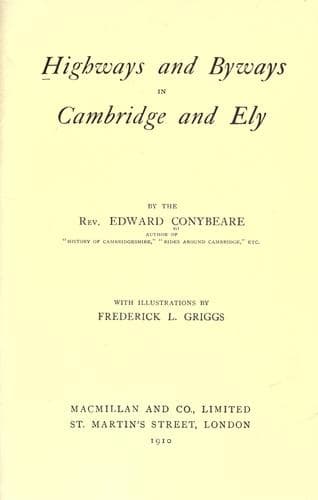
Highways and Byways in Cambridge and ElyConybeare, John William Edward
History
Highways and Byways in Cambridge and Ely
Conybeare, John William Edward
Cambridgeshire (England) -- Description and travel; Isle of Ely (England) -- Description and travel
Peter Gunning, who was Bishop of Ely for eight years, from 1675 to
1683, had likewise faced imprisonment for the sake of his religion. As
vicar of the church of St. Mary the Less at Cambridge, and later at
Tunbridge, while on a visit to his mother, he preached sermons in
support of King Charles the First and in defence of the Church of
England, which excited against him the resentment of the prevailing
faction and led to his imprisonment. But before long he regained his
liberty and returned to Cambridge, where, on his refusing to subscribe
the Covenant, he was deprived of the Fellowship he held at Clare Hall.
He then sought refuge with the King at Oxford; and on the surrender of
that city to the Parliamentary forces betook himself to London, where
his use of the English Liturgy, and the sermons preached by him in the
Exeter House Chapel, drew down upon him the censure of Cromwell in
person. At the Restoration he was given posts of high responsibility.
He was called upon to assist at the Savoy Conference in the
remodelling of the Book of Common Prayer, in which the "Prayer for all
sorts and conditions of men," compiled by him, took its place. At
Cambridge he held successively within the next ten years the
Masterships of St. John's and of Corpus Christi, and was also
successively the Lady Margaret and the Regius Professor of Divinity;
he was appointed to the See of Chichester in 1670, and in 1675 was
translated to Ely, where, after eight years, he died. It is recorded
of him that in 1678 he had the courage to raise in the House of Lords,
where he sat as Bishop of Ely, a strong protest against the shameful
Test Act, which imposed upon all civil servants of the Crown, all
officers, both in army and navy, all professional men, lawyers,
doctors, and teachers of every grade, that odious formula, the
so-called Royal Declaration, an age-long source of bitterness, now,
happily, at last, no longer Royal.
Francis Turner likewise, who held the See from 1684 till 1691, was yet
another Bishop of Ely who suffered for his principles. He was one of
the famous seven bishops committed to the Tower in 1688 for refusing
to promulgate James the Second's Declaration of Indulgence, which they
regarded as an unjustifiable stretch of the royal prerogative; and
later he was deprived of his bishopric for declining, as a non-juror,
to take the oath of allegiance to William and Mary, whom he considered
to be usurpers of the royal dignity; showing thus (as Sir Walter Scott
puts it) that while he could, in the interests of what he held to be
justice, resist his sovereign, even in the plenitude of his power,
like a free-born subject, so he would at all sacrifices maintain what
he believed to be his king's legitimate rights, even in the depths of
his adversity, like a loyal one.
[Footnote 223: See page 274.]
CHAPTER XVI
Public-domain text, read in full here on John Shaqi.
Reviews
Reviews
No reviews yet
Be the first to share your thoughts on this work.
Elsewhere in the archive
Join the Discussion
Join the discussion
Sign in to leave a comment or review.
Sign InorCreate an account