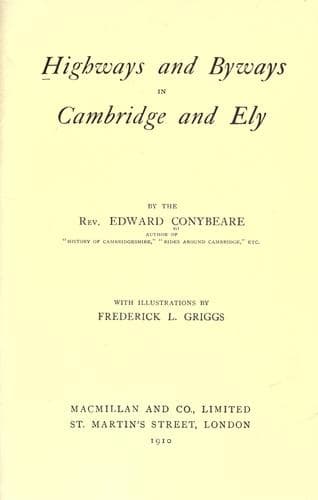
Highways and Byways in Cambridge and ElyConybeare, John William Edward
History
Highways and Byways in Cambridge and Ely
Conybeare, John William Edward
Cambridgeshire (England) -- Description and travel; Isle of Ely (England) -- Description and travel
Approach to Ely.--The Park.--Walpole Gate.--Crauden
Chapel.--Western Tower,
Galilee.--Nave.--Baptistery.--Roof.--Prior's
Door.--Cloisters.--Owen's Cross--Octagon.--Alan's
Grave.--Transepts.--St. Edmund's Chapel.--Choir
Stalls.--Presbytery.--Norman Piers.--Reredos.--Candlesticks.
The foregoing pages have taught us something of the history of Ely
Cathedral, of the men and women who have loved it and worked for it;
of those who have defaced and pillaged it; of the wars and revolutions
that have surged around it. Now we propose to visit it, and to see for
ourselves the very stones which, though silent, can speak to us;
hoping to be favoured with a fine day, that we may be able to study
the Minster advantageously from without as well as from within. And
let us come provided with a glass, for much of the best carved work is
high above our heads.
It may be unenterprising to come to Ely by rail; but yet there is no
approach that can give us a finer impression of the Minster than we
gain by our first view of it from the train, whether we arrive from
the north or from the south. In either case we have been travelling
over flat dull country, when suddenly there stands up before our eyes
the "stately fane" of which we have heard so much, and our first
impulse is to show her some token of reverence. We take a good look at
the pile of building before us, and we resolve not to forget our first
sight of this our new friend. Well did the quaint historian, Thomas
Fuller, write of Ely Minster in 1660, "This presenteth itself afar off
to the eye of the traveller, and on all sides, at great distance, not
only maketh a promise, but giveth earnest of the beauty thereof."
Leaving Ely station, our best course will be to walk toward the
Cathedral, taking the second turn to the right. This brings us into a
commonplace street; where, however, we should notice on our right a
row of thatched cottages, with their overhanging upper storeys, that
have survived from olden days. Just opposite these cottages is an iron
gateway which invites us into the Cathedral "Park," an undulating
piece of ground some sixteen acres in extent grazed by cattle and
sheep, its highest point being an artificial mound, now densely
clothed with trees, called Cherry Hill. An award of the seventeenth
century speaks of it as Mill Hill, an early print shows it topped by a
windmill; so here, doubtless, stood the windmill of the Monastery,
mentioned in the epitaph on Alan of Walsingham as one of the four
wonders of Ely due to his genius (the others being the Lantern, the
Lady Chapel, and the Abbey vineyard). The place of the mill (which
itself superseded the Norman keep built on this eminence by William
the Conqueror) is now occupied by a monument in memory of Bentham, the
historian of the Abbey of Ely, who wrote in the eighteenth century.
Public-domain text, read in full here on John Shaqi.
Reviews
Reviews
No reviews yet
Be the first to share your thoughts on this work.
Elsewhere in the archive
Join the Discussion
Join the discussion
Sign in to leave a comment or review.
Sign InorCreate an account