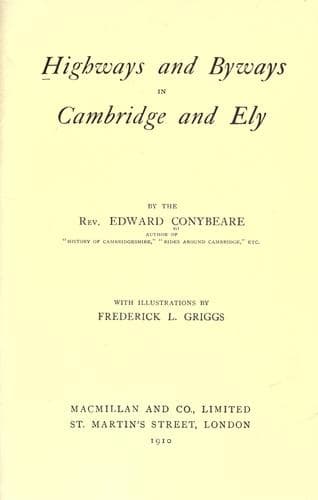
Highways and Byways in Cambridge and ElyConybeare, John William Edward
History
Highways and Byways in Cambridge and Ely
Conybeare, John William Edward
Cambridgeshire (England) -- Description and travel; Isle of Ely (England) -- Description and travel
We must not, however, suppose that the whole of this immense tract was
always morass. Oscillations in the land level have more than once
raised it high enough and long enough for great forests to clothe it;
the trees of which, frequently of giant size, are constantly exhumed
from the peat which the later depressions have formed over them.[233]
The last of these forests seems to have lingered on into Roman times.
A Roman roadway may still be traced, running east and west across the
whole breadth of the district, from Denver, at the south-western point
of the Norfolk uplands, to Stanground, near Peterborough, on the
Huntingdonshire mainland. The Fens must have been very different from
what they afterwards became for such a road to be in use. But before
the collapse of Roman Britain in the fifth century of our era all
seems to have gone to fen once more; and the islets in it served as a
refuge for the remnant of the British population when the flood of the
Anglo-Saxon Conquest burst over the land.[234]
[Footnote 233: See p. 196.]
[Footnote 234: See p. 168.]
These islets number some thirty and more, and vary considerably in
size. Far the largest is that on which Ely stands, the southern part
of which has been spoken of in Chapter XII. At its extreme northern
point, on a subsidiary islet of its own, is the large village of
Littleport, chiefly memorable as having been the focus of a most
serious agrarian outbreak, which in the year 1816 convulsed the
district. Widespread agricultural distress marked the first decades of
the nineteenth century. The wholesale enclosure of the common fields
and the waste lands brought with it no small suffering to the
peasantry; who everywhere lost, by the Enclosure Acts, the advantages
which the waste lands had afforded them, receiving in exchange a
scanty portion of "town land" in each parish, the rent of which is
applied to local charities. And in many instances the policy of the
Government placed these "town lands" in the least accessible corner of
the parish; for the express purpose of preventing labourers from
acquiring allotments in them and thus becoming less dependent on their
wages. The draining of the fens, moreover, which was then in full
progress, by exterminating the old abundance of fish and wildfowl
deprived the marsh-men at once of their chief recreation and their
most savoury food. Wages were only nine shillings a week, while wheat
was no less than five guineas a quarter. These grievances actually
drove the peasantry to arms, not without countenance from sympathisers
of a superior class, who felt that the demand of the rioters for wages
enough to purchase a stone of flour a week, which was all they asked,
could not be called unreasonable.
Public-domain text, read in full here on John Shaqi.
Reviews
Reviews
No reviews yet
Be the first to share your thoughts on this work.
Elsewhere in the archive
Join the Discussion
Join the discussion
Sign in to leave a comment or review.
Sign InorCreate an account