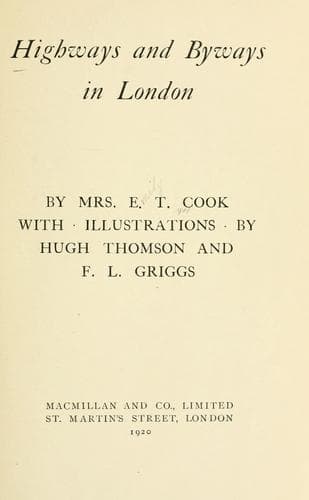
Highways and Byways in LondonCook, Emily Constance Baird
History
Highways and Byways in London
Cook, Emily Constance Baird
London (England) -- Description and travel
The glamour of a romantic past, the spirit of Chaucer and of
Shakespeare, may still attach to Southwark; the playhouses and
gaieties of Elizabeth's time may yet leave some faint record there;
but it is, after all, by another of Fate's strange ironies, the Child
of the Marshalsea, the boy brought up in wretchedness and squalor, who
has glorified by his genius the place, the whole district, where he so
suffered in early youth. Other and greater men have told London's
history in the past; but Dickens, whose grave is still faithfully
tended in Westminster Abbey while those of the mightier dead are long
forgotten, Dickens, who cared everything for the lower, warmer phases
of humanity; Dickens, to whom every grimy London stone was dear, and
every dirty cockney child a creature of infinite possibilities;
Dickens, whose name will be ever dear to the faithful Londoner; is the
modern chronicler of the great city.
CHAPTER VII
THE INNS OF COURT
"The perplexed and troublous valley of the shadow of the
law."--_Dickens._
"those bricky towers,
The which on Thames' broad aged back doe ride,
Where now the studious lawyers have their bowers,
There whilom wont the Templar knights to bide,
Till they decayed through pride."--_Spenser._
Among the by-ways that open suddenly out of the highways of London,
are there any more attractive than the Inns of Court? which, in an
almost startling manner, bring into the whirl of Holborn, and the din
of Fleet Street, something of the charm of an older and more peaceful
world. No parts of London are more delightful, and few call up more
interesting historic associations. Picturesque and charming old
enclosures,--full of that mysterious and intangible "romance of
London" that appealed so strongly to writers such as Lamb, Dickens,
and Nathaniel Hawthorne,--the Inns of Court have in their time
sheltered many great men. How strange and how unexpected, in the very
heart of busy London, are these quiet old-world quadrangles, of calm,
collegiate aspect, of infinite peace; a peace that seems perhaps more
intense in contrast with the outside, just as the London "close" of
greenery seems all the greener for its being set amid the surrounding
grime, shining "like a star in blackest night." Historic houses,
indeed, in every sense, are these old Inns, with their worm-eaten
wooden staircases, worn into holes by the passage of countless feet;
their panelled walls inscribed with many names; their floors often
crazy and slanting as the decks of a ship in mid-ocean. Even the
so-called "laundresses" who act as caretakers and servants in these
establishments, seem as though they belonged to former centuries, and
were, in a manner, impervious to the flight of time. Many have been
the noted residents in the Inns; the most noted, perhaps, of those in
the Temple are Fielding, Charles Lamb, and the poet Cowper; Dr.
Johnson lived once in Staple Inn, writing _Rasselas_ there "in the
Public-domain text, read in full here on John Shaqi.
Reviews
Reviews
No reviews yet
Be the first to share your thoughts on this work.
Elsewhere in the archive
Join the Discussion
Join the discussion
Sign in to leave a comment or review.
Sign InorCreate an account