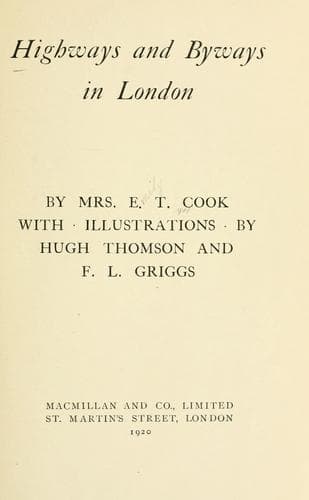
Highways and Byways in LondonCook, Emily Constance Baird
History
Highways and Byways in London
Cook, Emily Constance Baird
London (England) -- Description and travel
unvisited nooks in the busy City. "The world forgetting, by the
world forgot," is truer of these byways than of many more rural
places. For the eddies of a big river are always quieter than the
main stream of a small canal. In the world, yet not of it, are, too,
these strangely old-fashioned rectories, sandwiched in between
tall, overhanging city warehouses.
But the sprinkling of old churches, with their odd, abbreviated
churchyards, that are still to be found amid the busy life of the City
of London, hardly does more than faintly recall that picturesque and
poetic time when the church and the convent were pre-eminent. The
great temporal power of the Church in London, that held sway during
long centuries, is vanished, forgotten, supplanted as if it had never
been. Do the very names of Blackfriars and Whitefriars suggest, for
instance, to us, "the latest seed of time," anything more than the
shrieking of railway terminuses, or the incessant din of printing
machines? For, while the memory of the "Grey Friars" and that of the
Carthusians is still honoured and kept green in the dignified
"foundations" of Christ's Hospital and of the Charterhouse,--the
orders of the "White" and "Black" Friars, of the Carmelites, and the
stern Dominicans, have descended to baser and more worldly uses.
Destroyed at the Reformation, its riches alienated, its glory
departed, the splendid Abbey Church of the Dominicans came to be used
as a storehouse for the "properties" of pageants; "strange fate," says
Sir Walter Besant, "for the house of the Dominicans, those austere
'upholders of doctrine.'" For the dwelling of the "Carmelites," or
"White Friars," an Order of "Mendicants" these,--another destiny
waited--a destiny for long lying unfolded in the bosom of our
"wondrous mother-age." Mysterious irony of Fate! that where the
Carmelite monks, in their Norman apse, prayed and laboured; where the
Mendicant Friars wandered to and fro in the echoing cloister, the
thunder of the printing-press should have made its home:
"There rolls the deep where grew the tree,
O earth, what changes hast thou seen!
There, where the long street roars, hath been
The stillness----"
--The "_Daily Mail_ Young Man"--that smart product of a later
age--has now his home in Carmelite Street; the "Whitefriars' Club" is
a press club; the gigantic machines that print the world's news shake
the foundations of St. Bride's; and the shabby hangers-on of Fleet
Street--though of a truth, poor fellows, often near allied to
mendicants--are yet, it is to be feared, only involuntarily of an
ascetic turn. The contrast--or likeness--has served to awaken one of
Carlyle's most thunderous passages: "A Preaching Friar,"--(he
says),--"builds a pulpit, which he calls a newspaper:
Public-domain text, read in full here on John Shaqi.
Reviews
Reviews
No reviews yet
Be the first to share your thoughts on this work.
Join the Discussion
Join the discussion
Sign in to leave a comment or review.
Sign InorCreate an account