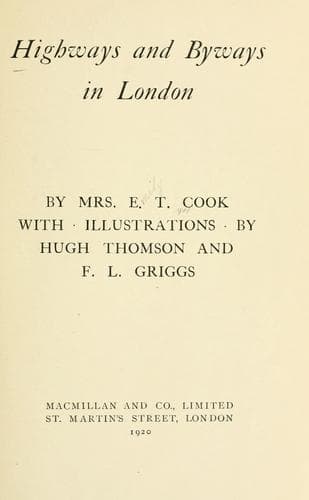
Highways and Byways in LondonCook, Emily Constance Baird
History
Highways and Byways in London
Cook, Emily Constance Baird
London (England) -- Description and travel
"Look well" (he continues),--"thou seest everywhere a new
Clergy of the Mendicant Orders, some bare-footed, some
almost bare-backed, fashion itself into shape, and teach and
preach, zealously enough, for copper alms and the love of
God."
Carlyle, apparently, nursed an old grudge against the press,--for this
is not the only occasion when he fulminates against the new order of
Mendicants. The theatres, also, that succeeded the monasteries of
Blackfriars were, here too, supplanted by the Press; under
Printing-House-Square only lately, an extension of the _Times_ Office
brought to light substantial remains.
But the Church was not the only mediæval beautifier of London; as her
temporal power and splendour waned,--the splendour of the merchants
grew and flourished. For the great supplanter of the power of the
Church was, as already hinted, the power of the City Companies. These
immense trades-unions began to rise in the fourteenth century, when
the old feudal system gave way to the civic community;--and they
increased greatly in strength after the dissolution of the
Monasteries. These companies incorporated each trade, and had supreme
powers over wages, hours of labour, output, &c. In the beginning they
were, like everything else, partly religious, each company or "guild"
having its patron saint and its special place of worship;--the
Merchant Taylors, for instance, being called the "Guild of St.
John";--the Grocers, the "Guild of St. Anthony"; while St. Martin
protected the saddlers, and so on. These guilds in time receiving
Royal charters, became very rich and powerful, till the year 1363
there were already thirty-two companies whose laws and regulations had
been approved by the king. If any transgressed these laws, they were
brought before the Mayor and Aldermen. We have still the Mayor and
Aldermen, but the city companies (whose principal function was the
apprenticing of youths to trades), have merely the shadow of their
former authority, and their business is now mainly charitable,
ceremonial, and culinary. Yet though their powers are diminished,
their splendid "halls" are still among the most interesting "sights"
of the City. Visits to these massive and solid palaces, some of them
of great splendour, and rising like pearls among their often (it must
be confessed) unsavoury surroundings, give a good idea of the immense
wealth of those mediæval merchant princes, and help the stranger to
realize the strength of that power that was able to resist the
attempts of kings to break its charter. Such sturdy independence, such
insistence on her civic rights, has always been a main element of
London's greatness.
[Illustration: _When the Strand is up._]
Public-domain text, read in full here on John Shaqi.
Reviews
Reviews
No reviews yet
Be the first to share your thoughts on this work.
Join the Discussion
Join the discussion
Sign in to leave a comment or review.
Sign InorCreate an account