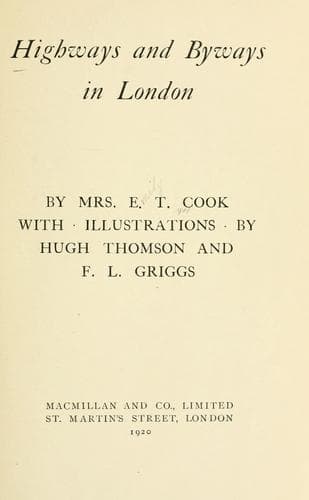
Highways and Byways in LondonCook, Emily Constance Baird
History
Highways and Byways in London
Cook, Emily Constance Baird
London (England) -- Description and travel
Strange, indeed, are Fate's ironies! Queen Elizabeth and her cousin,
Mary Queen of Scots, rest in the two side aisles of Henry VIIth's
chapel in stately tombs, much resembling one another, erected, with
praiseworthy impartiality, to his "dearest mother" and his "dear
sister," by King James I. In the Stuart vault, close to the unhappy
Queen of Scots, is buried Lady Arabella Stuart, "childe of woe"; that
poor prisoner of the Tower, separated from her loved and just-wedded
husband and kept by her cousin James I. in durance vile, till "her
reason left her," and she died. Even in death her disgrace followed
her, when, for fear of being thought too respectful to one "dying out
of royal favour," the authorities dared not even provide her poor body
with an adequate coffin! Poor "Ladie Arbell!" Of all the tragedies of
English history, none are sadder or more cruel than hers, or reflect,
more vividly, the inhumanity of the time.
The interior of Henry VIIth's Chapel,--in its darkened glory of golden
light, with its fretted roof, its "walls wrought into universal
ornament," its many statues and sculptures, and contrasted dark oak
choir stalls, with the banners of their owners, the Knights of the
Bath, hanging overhead,--is very fine. In the centre of the chapel is
the magnificent tomb of Henry VII., the third founder of the Abbey,
who, with much of the feeling of the men who built the Pyramids,
determined this as the splendid mausoleum of his race. The monument,
enclosed by a screen, or "closure," of gilt copper, is by Torregiano.
Here, with Henry, is buried his wife, Elizabeth of York, in marriage
with whom the king finally united the York and Lancaster cause. Hither
was brought in state, in 1502, the body of this last Queen of the
House of York, dead at twenty-seven, her waxen effigy, with
dishevelled hair and Royal robes, lying outside her coffin:
"The first stone of the splendid edifice founded by Henry
VII., and which was to contain all the glory of his race,
had only been laid a month when his wife, Elizabeth of York,
died. She lies in its first grave. More wrote an elegy on
the Queen, who died in giving birth to a child in the
Tower:--
"Adieu, sweetheart! my little daughter late,
Thou shalt, sweet babe, such is thy destiny,
Thy mother never know; for here I lie.
At Westminster, that costly work of yours,
Mine own dear lord, I now shall never see."
In front of the chantry of his grandparents, is the altar-tomb of
Edward VI., the boy-king of sixteen, "flower of the Tudor name"; a
small portion of the frieze of his ancient monument, also by
Torregiano, has survived Republican zeal, and has been let into the
more modern structure.
Public-domain text, read in full here on John Shaqi.
Reviews
Reviews
No reviews yet
Be the first to share your thoughts on this work.
Elsewhere in the archive
Join the Discussion
Join the discussion
Sign in to leave a comment or review.
Sign InorCreate an account