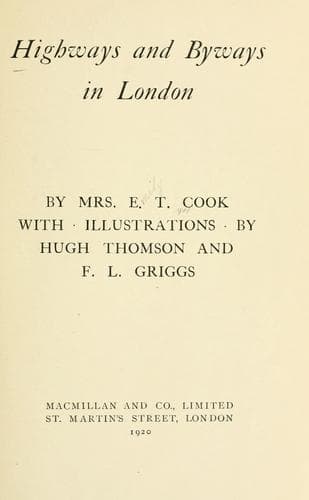
Highways and Byways in LondonCook, Emily Constance Baird
History
Highways and Byways in London
Cook, Emily Constance Baird
London (England) -- Description and travel
And it is altogether in the fitness of things that the river should be
both introduction and entrance gate, so to speak, of modern London.
For it is the river, it is our "Father Thames," indeed, that has made
London what it is. In our childhood we used to learn in dull geography
books, as inseparable addition to the name of any city, that it was
"situated" on such-and-such a river; facts that we then saw little
interest in committing to memory, but, nevertheless vastly important;
how important, we see from this city of London. For London is, and
was, primarily a seaport. In Sir Walter Besant's interesting pages may
be read the story of the early settlers--Briton, Roman, Saxon,
Norman--who successively founded their infant settlements on this
marshy site, and had here their primitive wharves, quays, and trading
ships for hides, cattle, and merchandise. It is the river, more than
anything else, that recalls the past history of London. For London,
ever increasing, ever rebuilt, has buried most of her eventful past in
an oblivion far deeper than that of Herculaneum. Nothing destroys
antiquity like energy; nothing blots out the old like the new. London,
ever rising, like the phoenix, from her own ashes, has by the intense
vitality of her "to-days" always obliterated her "yesterdays." It is
only in dead or sleeping towns that the ashes of the past can be
preserved in their integrity, and London has ever been intensely
alive. Yet, gazing on the silvery flow of the river, we can imagine
the Roman embankment, the hanging gardens, that once stretched from
St. Paul's to the Tower; the Roman city, with its forums and
basilicas, that once crowned prosaic Ludgate Hill--Roman pinnace,
Briton coracle, Saxon ship, Tudor vessel--we can see them all in their
turn--crowned by the spectacle of Queen Elizabeth in her gaily-hung
state barge, with her royal procession; or, in more mournful key, her
body, on its death-canopy--a barge "black as a funeral scarf from
stern to stem," on that sad occasion when
"The Queen did come by water to Whitehall.
The oars at every stroke did teares let fall."
If in the crowded day of London--with the shouting of bargees, the
whistle of steam-tugs, and the puffing of the smoke-belching trains
overhead, indulgence in such dreams is well-nigh impossible,--in the
mysterious night, when the slow misty moon of London climbs, it is
easy, even from an alcove of Waterloo Bridge, to indulge the fancies
of
"That inward eye
Which is the bliss of solitude."
Public-domain text, read in full here on John Shaqi.
Reviews
Reviews
No reviews yet
Be the first to share your thoughts on this work.
Join the Discussion
Join the discussion
Sign in to leave a comment or review.
Sign InorCreate an account