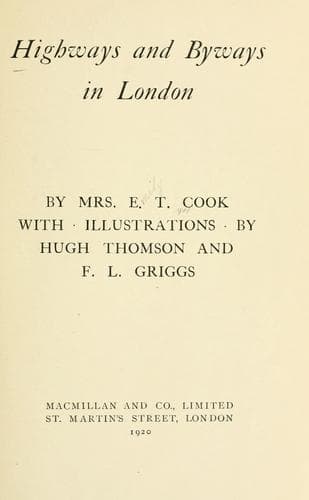
Highways and Byways in LondonCook, Emily Constance Baird
History
Highways and Byways in London
Cook, Emily Constance Baird
London (England) -- Description and travel
The so-called "penny steamers" of London, which run, during the summer
months, at very cheap rates between London Bridge and Chelsea, form
the best way of seeing and appreciating the vast city. For those who
do not mind rather close contact with "the masses"--braying
accordions, jostling fish-porters, sticky little boys, and other
inseparable adjuncts of a crowd whose "coats are corduroy and hands
are shrimpy"--this mode of becoming acquainted with London will be
found very satisfactory. The ways of the said steamers are often, it
is true, somewhat erratic; yet if, on a warm June day, the stranger go
down to the river in faith, his expectancy will generally be rewarded.
Up comes the puffing, creaky little tug, making the tiny landing stage
vibrate with the sudden shock of contact; there is an immediate rush
to embark, and, on a fine day, you are, at first, happy if you get
standing-room. Cruikshank's pictures, Dickens's sketches--how
suggestive of these is the motley crowd of faces that line the
boat,--faces on which the eternal "struggle for life" has printed
lines, as it may be, of carking care, of blatant self-satisfaction, of
crime and degradation. To quote William Blake, the poet-painter,--a
Londoner, too, of the Londoners:
"I wander through each chartered street
Near where the chartered Thames does flow,
A mark in every face I meet,
Marks of weakness, marks of woe."
The fine, broad Chelsea reach of the river, looking up towards Fulham
from the Albert chain-bridge, is wonderfully picturesque. Here,
especially on autumn nights, may be seen in all their splendour the
brilliant sunsets that Turner loved to paint, and that, propped up on
his pillow, he turned his dying eyes to see. The ancient and
unassuming little riverside house where Turner spent his last days is
still standing; but its tenure is uncertain, and it may soon vanish.
It stands (as No. 119)--towards the western end of Cheyne Walk--the
walk that begins in the east so magnificently, and decreases, as
regards its mansions, in size and splendour as it approaches the old
historic red-brick church of Chelsea. Yet, small as Turner's riverside
abode is, it is more celebrated than any of its neighbours, for it was
here that the greatest landscape painter of our time lived. Here,
along the shores of the river, flooded at eve "with waves of dusky
gold," the shabby old man with such wonderful gifts used to wander in
search of the skies and effects he loved; here he was hailed by cheeky
street arabs, as "Puggy Booth" (the legend of the neighbourhood being
that he was a certain retired and broken-down old "Admiral Booth").
Here he sat on the railed-in house-roof to see the sun rise over the
river, and here, when too weak to move, his landlady used to wheel his
chair towards the window that he might see the skies he so loved. "The
Sun is God," were almost his last words. Thus, he who as a boy of
Maiden Lane had spent his early years on the river near London
Public-domain text, read in full here on John Shaqi.
Reviews
Reviews
No reviews yet
Be the first to share your thoughts on this work.
Join the Discussion
Join the discussion
Sign in to leave a comment or review.
Sign InorCreate an account