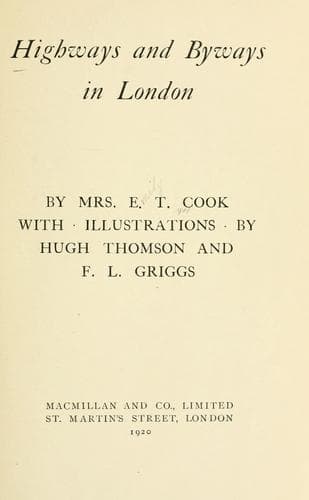
Highways and Byways in LondonCook, Emily Constance Baird
History
Highways and Byways in London
Cook, Emily Constance Baird
London (England) -- Description and travel
The interior of the Tate Gallery (its proper denomination is, I
believe, "the National Gallery of British Art,") is very delightfully
planned. A pretty fountain fills the central hall of the gallery under
the dome; an adornment as refreshing as it is unexpected. For London,
the home of riches, is strangely niggardly with her fountains. Yet
Rome, the city of fountains, had to bring all her water for many
miles, and over endless aqueducts! The immediate riverside
surroundings of the Tate Gallery are, as described, hardly grandiose;
yet the timber-wharves and stone-cutters' sheds that here share the
muddy banks with the ubiquitous tribe of London "Mudlarks," are not
without their picturesque "bits." Old boats sometimes reach here their
final uses; and even portions of old derelicts, like the "Téméraire,"
often find their way here at last. Witness advertisements like the
following:
FIRES.--Logs of old oak and ship timber, from Old Navy ships
broken up, in suitable sizes, for sitting-room use, so
famous for beautifully coloured flames, can only be obtained
from the ship breaking yard of ---- Baltic Wharf, Millbank,
S.W.
It is, however, only the wharves and the mudlarks that are visible
from the river itself; for the quaint gates of these timber-yards,
opening on to the Grosvenor Road, and surmounted by their "signs" in
the shape of ghostly white figure-heads--the figure-heads of real
ships--are only visible to those who make their way along this
mysterious region by land. These colossal creatures, indeed,
projecting often far into the road, pull up the pedestrian with such
alarming and human suddenness that it would surely require, in the
uninitiated, a strong mind and a good conscience to travel this way
alone on a dark night.
The keynote of London is ever its close juxtaposition of splendour and
misery, "velvet and rags." Therefore, after skirting the shore of
Millbank, it strikes the Londoner as quite natural, and in the usual
order of things, that he should suddenly and without any preface find
his vessel gliding, in an abrupt hush, underneath the terrace-wall of
the most well-known and most be-photographed edifice in London; under
the high vertical wall, with its softly lapping waters, that guards
the terrace of the Houses of Parliament. Classic retreat, where none
but the specially bidden may enter! The great towers, with the vast
building they surmount, darken, for a moment, all the stream by the
intense shadow they cast, to mirror themselves anew in charming
proportion as we descend the stream and they recede.
Public-domain text, read in full here on John Shaqi.
Reviews
Reviews
No reviews yet
Be the first to share your thoughts on this work.
Join the Discussion
Join the discussion
Sign in to leave a comment or review.
Sign InorCreate an account