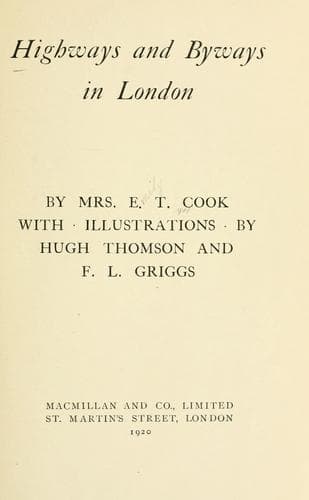
Highways and Byways in LondonCook, Emily Constance Baird
History
Highways and Byways in London
Cook, Emily Constance Baird
London (England) -- Description and travel
"In Brick Lane ... scenes are to be witnessed on Sunday
mornings which afford a companion picture to those in
Whitechapel. The East End English have also, like the Jews,
their 'poor man's market,' and where Shoreditch, Bethnal
Green and Spitalfields meet at the northern part of Brick
Lane, which is in Spitalfields, the poorest and meanest of
them are to be found. In the early part of Sunday morning,
for a couple of hours or so, there is a woman's market where
cast-off clothes, tawdry finery, and the newest things in
hats and feathers are bartered. Heterogeneous heaps of
clothing, boots and shoes included, lie spread over the
ground, and some amusing scenes are to be witnessed. Pass
along Sclater Street and new scenes meet the eye. The women
are left behind, and men and boys are met with. Instead of
old clothes one sees and hears twittering birds. Here come
the pigeon fanciers from all parts of Bethnal Green and
Spitalfields; birds of all kinds are to be bought, and the
noise and bustle are in striking contrast to the subdued,
sorrow-stricken tone of the women's market. It does not
require any long acquaintance with these scenes to discover
that the men are fonder of their birds than of their wives.
Nowhere is bird-fancying and pigeon-breeding more general
than in the crowded East End. Where one would think there
was not house-room enough or food enough for human
occupants, prize birds of great value are reared--most
probably with money that should have gone to feed and clothe
the children."
The special markets where the poor buy and sell are not, however,
exactly tempting to the well-to-do, unless in search of "copy" or
other experience. For those London visitors who do not appreciate the
slums, yet whose olfactory organs are not too fastidious, the big
London markets, Covent Garden, Smithfield, Billingsgate, will perhaps
afford a sufficient experience in that line. Billingsgate is the most
perilous excursion of the three. Its aroma is strong and lasting, and
the stranger in its diverging courts and alleys runs considerable
danger of having winkle-barrels or fish crates descend on his devoted
head, as they are lowered from the wharves on to their respective
carts. Yes, a little of Billingsgate will undoubtedly go a very long
way; yet it is an interesting place to have seen, and the strange,
sudden appearance of ancient churches,--St. Dunstan's, St. Magnus, St.
Mary-at-Hill,--incongruously calm amid the wild turmoil all round
them,--gives a momentary peace even "amid the City's jar." The
language of Billingsgate fish-wives and porters is proverbial, yet it
is perhaps hardly worse than in many other less fishy quarters of
London. The Coal Exchange, opposite Billingsgate, has, with its broad
flight of steps, on which people sit, itself a kind of ecclesiastical
look. The fish market opens at five in the morning.
Public-domain text, read in full here on John Shaqi.
Reviews
Reviews
No reviews yet
Be the first to share your thoughts on this work.
Elsewhere in the archive
Join the Discussion
Join the discussion
Sign in to leave a comment or review.
Sign InorCreate an account